We pulled the most useful online dating statistics on safety from three official sources: the FBI, the Federal Trade Commission (FTC) and Pew Research Center. Every number below links to its source. The short version: romance scams are growing fast, and about half of people who use dating apps have faced harassment.
Key Online Dating Statistics (2026)
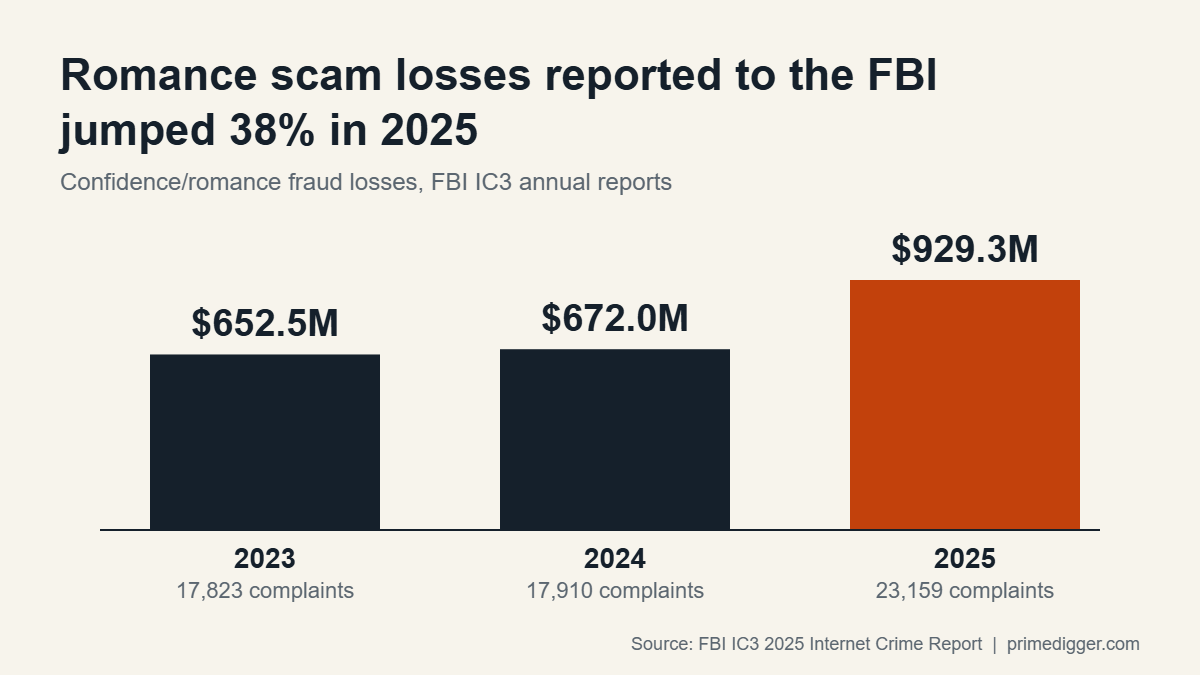
- $929.3 million was lost to romance and confidence scams reported to the FBI in 2025, up 38% from $672.0 million in 2024.
- 23,159 romance and confidence scam complaints reached the FBI in 2025, up 29% from 17,910.
- The FBI linked over $19 million of 2025 romance scam losses to AI tools, such as fake profiles and chat scripts.
- FTC reports show romance scam losses rose 22% in 2025, and nearly 60% of people who lost money said the scam started on social media.
- 48% of Americans who have used a dating site or app have faced at least one form of harassment (Pew).
- 52% of dating app users think they have come across a scammer (Pew).
Romance Scam Statistics
Romance scams are when someone builds a fake relationship online, then asks for money, gifts or “investment” help. Here is what victims reported to the FBI’s Internet Crime Complaint Center (IC3) over three years.
| Year | Complaints | Reported losses |
|---|---|---|
| 2023 | 17,823 | $652.5 million |
| 2024 | 17,910 | $672.0 million |
| 2025 | 23,159 | $929.3 million |
The FTC collects separate reports. In 2023 it received 64,003 romance scam reports with $1.14 billion in losses and a median loss of $2,000 per person. In 2025, the FTC said reported romance scam losses grew another 22%, and people who lost money to romance scams that began on social media reported $298 million in losses.
Both agencies say most scams are never reported, so the real numbers are likely higher.
Online Dating Harassment Statistics
Pew Research Center asked U.S. adults who have ever used a dating site or app about unwanted behavior. Women under 50 and LGB users reported much higher rates.
| Experience | All users | Women under 50 |
|---|---|---|
| Sent unwanted sexual messages or images | 38% | 56% |
| Kept being contacted after saying no | 30% | 43% |
| Called an offensive name | 24% | 37% |
| Threatened with physical harm | 6% | 11% |
| At least one of these | 48% | — |
LGB users were also more likely than straight users to receive unwanted sexual messages or images (56% vs. 34%).
How to Stay Safe on Dating Apps
- Never send money, gift cards or crypto to someone you have not met in person. Learn the signs in our guide to AI romance scams.
- Run a reverse image search on new matches. See is Tinder safe for the checks we recommend.
- Hide what strangers can see. Our guides cover Hinge and Bumble privacy settings and Tinder Passport location privacy.
- Check if your profile shows up in searches with how to find out if someone is on Tinder.
- Done dating? Delete your dating app account the right way so your data goes too.
Cite or Embed These Statistics
Journalists, bloggers and teachers are welcome to use these online dating statistics and the chart. Please credit PrimeDigger and link to this page.
Cite this page
PrimeDigger. (2026, October 27). Online Dating Statistics 2026: Scams, Harassment and Safety. https://primedigger.com/online-dating-statistics/
Embed the chart on your site (free, please keep the link)
Frequently Asked Questions
How much money is lost to romance scams?
Romance and confidence scams reported to the FBI cost victims $929.3 million in 2025, up 38% from 2024. The FTC also reported a 22% rise in romance scam losses in 2025.
How common is harassment on dating apps?
About half. Pew found 48% of Americans who have used a dating site or app faced at least one of four kinds of harassment, and 38% received unwanted sexual messages or images.
Do most romance scams start on dating apps?
Not always. The FTC says nearly 60% of people who lost money to a romance scam in 2025 said it started on social media.
Can I use these statistics?
Yes. Please credit PrimeDigger and link to this page. You can embed our chart with the free code above.
Sources
- FBI Internet Crime Complaint Center: 2025 Internet Crime Report (complaints and losses, 2023-2025).
- FTC: “Love Stinks” (2023 romance scam reports and losses).
- FTC Data Spotlight: scams on social media (April 2026).
- FTC: New trends in reports of imposter scams (May 2026).
- Pew Research Center: The experiences of U.S. online daters (February 2023).