

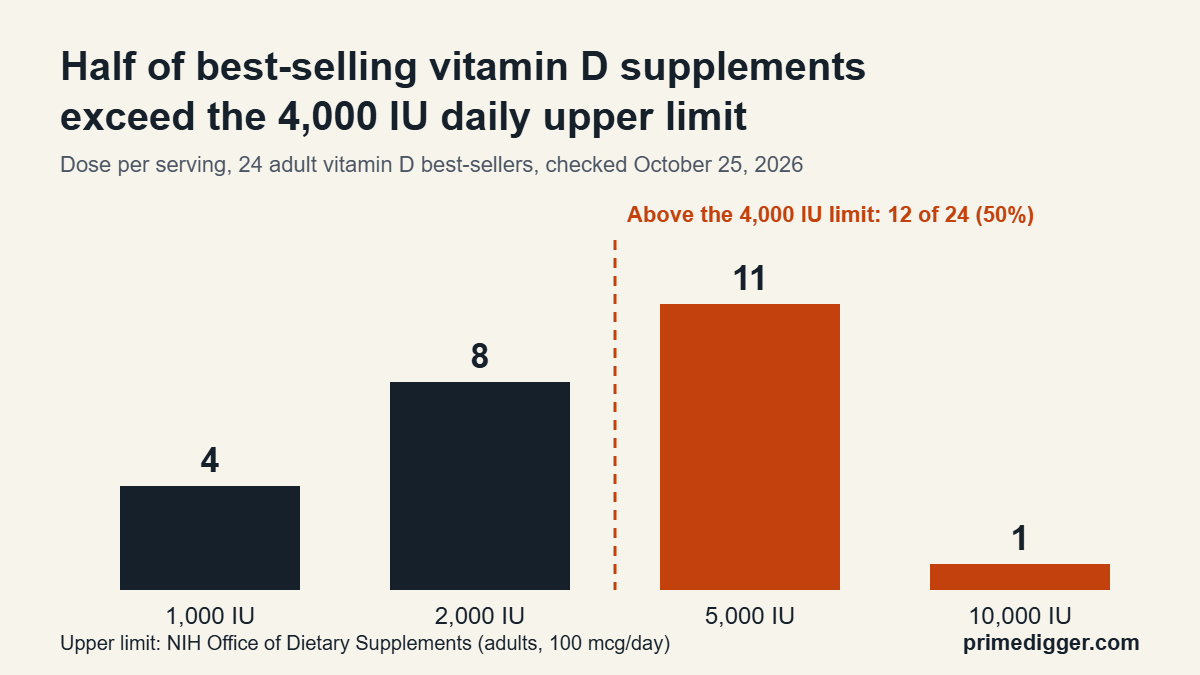
Our vitamin D supplement study checked the dose on 24 best-selling adult vitamin D supplements. Half of them, 12 of 24, contain more than 4,000 IU per serving, which is the daily upper limit the NIH sets for adults. Below are the full numbers, how we collected them, and a free chart you can use with credit.
Key Findings of Our Vitamin D Supplement Study
- 12 of 24 (50%) best-selling adult vitamin D supplements contain more than 4,000 IU per serving.
- 11 contain 5,000 IU and 1 contains 10,000 IU, 2.5 times the adult upper limit.
- Only 4 of 24 (17%) contain 1,000 IU per serving; 8 contain 2,000 IU.
- Vitamin D3 + K2 combinations were higher: of the 17 top-20 listings that showed a dose, 14 (82%) were above 4,000 IU, and 3 contained 10,000 IU.
| Dose per serving | Products | Share | Compared with the 4,000 IU limit |
|---|---|---|---|
| 1,000 IU (25 mcg) | 4 | 17% | Well under |
| 2,000 IU (50 mcg) | 8 | 33% | Under |
| 5,000 IU (125 mcg) | 11 | 46% | Above |
| 10,000 IU (250 mcg) | 1 | 4% | 2.5 times the limit |
Why the 4,000 IU Limit Matters
The NIH Office of Dietary Supplements sets the tolerable upper intake level for adults at 4,000 IU (100 mcg) of vitamin D a day. The recommended amount for most adults is 600 IU, or 800 IU over age 70. The NIH notes that vitamin D toxicity almost always comes from taking too much in supplements, not from food or sunlight.
A high dose is not always wrong. Doctors sometimes prescribe more for a short time to treat a deficiency. The problem is that many people pick a 5,000 IU bottle off a best-seller list without knowing it is above the daily limit, and then add a multivitamin that also contains vitamin D.
How We Did This Study
- On October 25, 2026, we took the top 30 products in a major online retailer’s Vitamin D Supplements best-seller list.
- We left out 6 products that are not adult vitamin D supplements (2 baby drops, 2 vitamin K2-only products and 2 combination formulas), leaving 24.
- We recorded the dose per serving shown on each product listing.
- We repeated the check for the top 20 vitamin D3 + K2 combinations; 17 showed a dose.
- Limits: we used the dose printed by each seller and did not lab-test products. Best-seller rankings change often, and some people take high doses weekly or under medical advice.
Vitamin D Dose Checker: Is Your Daily Total Too High?
Find the vitamin D amount per serving on your label, then see how your daily total compares with the NIH limits for adults.
Label maths only, not medical advice. 1 mcg = 40 IU. Adult upper limit 4,000 IU (100 mcg) a day; recommended amount 600 IU, or 800 IU over 70 (NIH Office of Dietary Supplements). Talk to your doctor before changing a dose.
Cite or Embed This Data
Journalists, bloggers and teachers are welcome to use these numbers and the chart. Please credit PrimeDigger and link to this page.
Cite this study
PrimeDigger. (2026, October 25). Vitamin D Supplement Study: Half of Best-Sellers Exceed the Safe Limit. https://primedigger.com/vitamin-d-supplement-study/
Embed the chart on your site (free, please keep the link)
Looking for a supplement that stays within the limit? See our guide to the best vitamin D supplement, with USP Verified picks at 1,000 and 2,000 IU.
Frequently Asked Questions
How much vitamin D is too much per day?
For adults, the NIH sets the upper limit at 4,000 IU (100 mcg) a day from all sources combined. Higher doses should only be taken for a set time under a doctor’s advice.
Is 5,000 IU of vitamin D too much?
It is above the 4,000 IU adult upper limit. In our study, 11 of 24 best-sellers contained 5,000 IU per serving. Some doctors prescribe it short term to treat a deficiency, so ask yours before taking it every day.
Can I use this data in my article?
Yes. Please credit PrimeDigger and link to this page. You can also embed our chart with the free code above.
Sources
- NIH Office of Dietary Supplements: Vitamin D fact sheet for health professionals (upper limit, recommended amounts, toxicity).
- NIH Office of Dietary Supplements: Vitamin D consumer fact sheet.
- PrimeDigger best-seller dose check, October 25, 2026 (data above).