
Quick Transparency Note:
Hey there! A quick heads-up: PrimeDigger is reader-supported. When you buy through links on our site, we may earn an affiliate commission. You never pay a single penny extra, and it helps us keep testing products and publishing honest, independent guides. We only recommend the tech and wellness gear we truly stand behind!
Do Hidden Camera Detectors Actually Work in 2026?
If you are looking at hidden camera detectors before your next Airbnb stay, you will be hit with hundreds of products boasting a 4.5-star rating. They claim to use “military-grade RF scanning” and “laser detection” to instantly expose hidden cameras, GPS trackers, and audio bugs.
But what happens when you bypass the marketing hype and look at the raw data? We deployed our Deep Search methodology to find out if these $50 gadgets actually protect your privacy, or if they just provide a false sense of security.
The Reality Check: Hidden Camera Detectors vs. Reddit Reality
The manufacturers of these hidden camera detectors, like the Jepwco G4 Pro and the JMDHKK K18, claim their tools can pinpoint exactly where a spy camera is hiding.
However, when you dig into cybersecurity and home-defense communities on Reddit (specifically r/privacy and r/homesecurity), the real-world user complaints tell a completely different story.
These devices are fundamentally just cheap Radio Frequency (RF) scanners. When users turn them on in an Airbnb, the devices immediately start beeping wildly. Why? Because they do not just detect spy cameras — they detect any active Wi-Fi or Bluetooth signal. The detector will ping constantly if it is near a smart TV, a microwave, a standard internet router, or even the cell phone in your own pocket.
Users report spending hours tearing apart hotel rooms to find a “bug,” only to realize the detector was just picking up the neighbor’s Wi-Fi network through the wall.
Supply Chain Digging: Cybersecurity Tech or White-Labeled Plastic?
When a product claims to protect your physical safety, you want it built by a reputable hardware engineering company.
These hidden camera detectors are textbook examples of white-label dropshipping. You can find the exact same “G4 Pro Spy Pen” available in bulk on sites like AliExpress and Gearbest for roughly $5 to $8 a piece.
You are not buying specialized cybersecurity hardware; you are buying a mass-produced, generic RF antenna in a plastic shell.
The Flaw Expose: The Secret Affiliate Sites Won’t Tell You
If you read standard tech review blogs, they will eagerly push you to buy these detectors so they can earn an affiliate commission. Because of this, they conveniently leave out the fatal flaw in how these devices operate.
Here is the secret: RF detectors only work if the hidden camera is actively transmitting data over Wi-Fi or cellular networks.
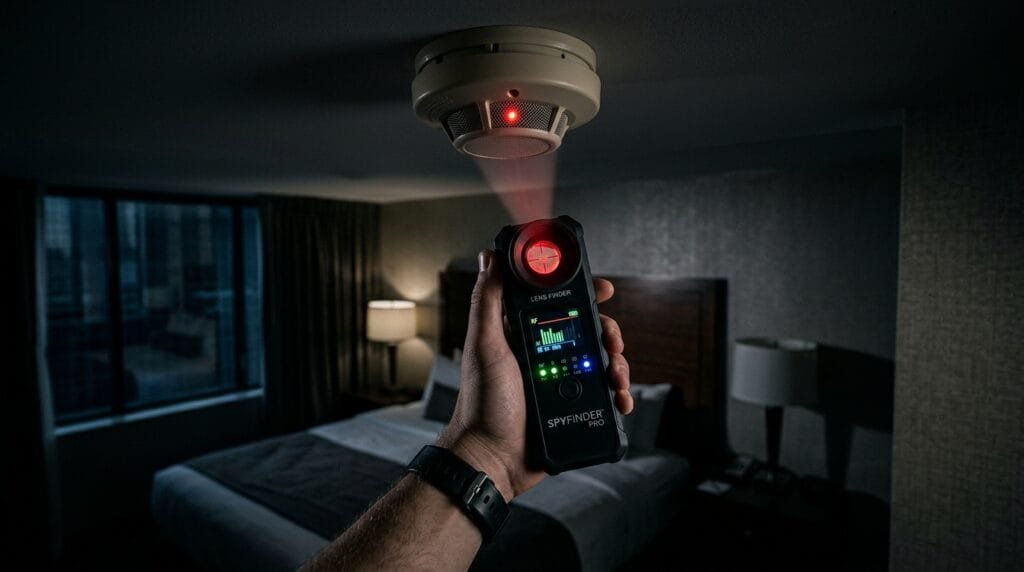
If a bad actor hides a camera in a smoke detector that simply records video to an internal, physical micro-SD card, an RF scanner will detect absolutely nothing. The scanner will remain completely silent, giving you a green light that the room is safe, while a hardwired or SD-card camera records your every move.
This is not a rare edge case. Many of the most disturbing hidden camera cases involve devices that store footage locally and are retrieved later — no wireless signal required.
What Actually Works: The PrimeDigger Protocol
If you want to do a real bug sweep of a rental property, the best tools are already available to you for free or at low cost.
Method 1: The Flashlight Sweep (Free)
Turn off all the lights in the room. Wait 2–3 minutes for your eyes to adjust to the dark. Turn on your smartphone’s flashlight and slowly sweep the walls, vents, mirrors, smoke detectors, and any decorative objects.
Camera lenses are highly reflective and will bounce the light back at you like a tiny, twinkling star. Look for purple or blue glints in dark areas. This method costs nothing and is more reliable than a cheap RF scanner.
Method 2: The Network Scan (Free)
Connect your phone to the Airbnb’s Wi-Fi network. Use a free network scanner app like Fing to see every device connected to that network. Look for unknown devices with manufacturer names like “Shenzhen,” “Generic,” or camera-related MAC address prefixes.
If you see a device you cannot account for, ask your host about it. A hidden camera connected to Wi-Fi will show up here — but remember, SD-card cameras will not.
Method 3: Thermal Imaging (Advanced)
For advanced sweeps, professional security consultants recommend using a plug-in thermal camera attachment for your phone — because a hidden camera will always generate abnormal heat inside an object, regardless of whether it is using Wi-Fi.
A camera running continuously produces a small but detectable heat signature. A thermal camera can spot this heat inside a smoke detector, a stuffed animal, or a wall socket in under 30 seconds.
The PrimeDigger Verdict
Hidden camera detectors are, for the most part, overpriced junk.
If you are concerned about hidden cameras in a rental property:
- Do a flashlight sweep in the dark
- Scan the Wi-Fi network for unknown devices
- Check logical hiding spots (smoke detectors, outlets, mirrors, decorative items)
- Consider a thermal camera attachment if you travel frequently
Your eyes, your phone’s flashlight, and a free network scanner are more effective than any $50 RF detector on the market.
For more on protecting your privacy while traveling, read our investigation into why your VPN travel router might not be as secure as you think.
Frequently Asked Questions
Do hidden camera detectors work on cameras that are turned off?
No. RF detectors require an active wireless signal. If the camera is powered off or uses local storage only, an RF detector will not find it. A flashlight sweep or thermal camera is more effective.
Can I use my phone to detect hidden cameras?
Yes. In addition to the flashlight method, you can use your phone’s camera to detect infrared light (many night-vision cameras emit IR). Turn off the lights, open your phone camera, and look for purple/white glowing dots on the screen.
Are expensive hidden camera detectors better than cheap ones?
Marginally. Professional-grade RF detectors ($300+) offer better frequency isolation and can distinguish between different signal types. However, they still cannot detect non-transmitting SD-card cameras.
What should I do if I find a hidden camera?
Do not touch it. Document it with photos and video. Contact local law enforcement immediately. In most jurisdictions, recording someone without consent in a private rental is a serious crime. Also report the listing to the rental platform.
Is there a hidden camera detector app that actually works?
No app can reliably detect hidden cameras without hardware assistance. Apps that claim to use your phone’s magnetometer to find cameras are largely ineffective. Stick to the flashlight and network scan methods.