Reader-supported: we may earn a commission from links on this page.
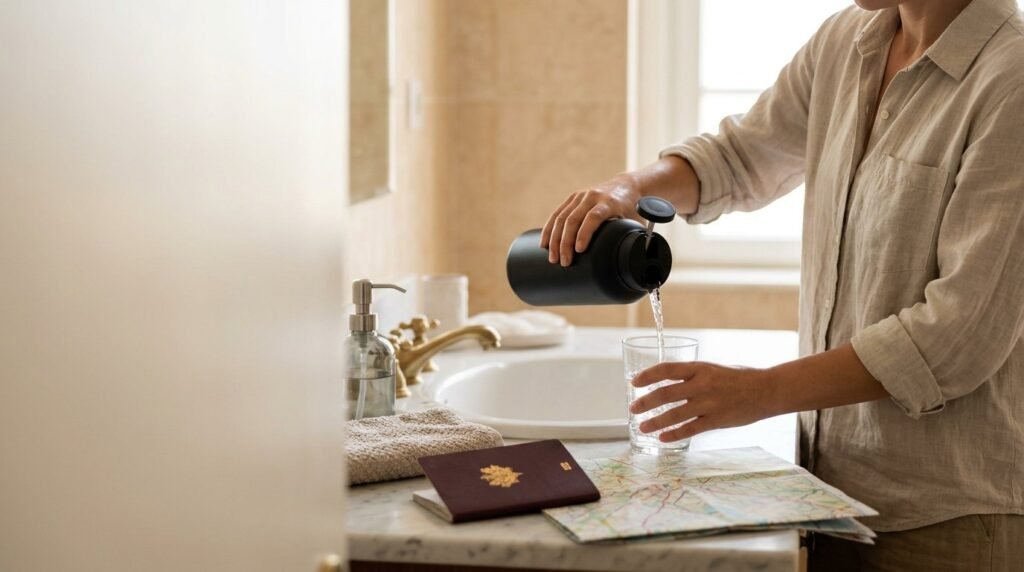
A water filter bottle sounds simple: fill it anywhere, drink safely. The problem is that most bottles are built for one job, and the box rarely tells you which one. Some only make tap water taste better. Some stop bacteria and parasites but not viruses. Only a few are built for the water you meet abroad. So we did something the big “best of” lists skip: we checked each bottle’s safety claims against the official certification lists and the CDC’s travel advice.
Quick pick: the right water filter bottle for your water
- Best for travel abroad: GRAYL GeoPress (a purifier, so it also targets viruses)
- Lighter travel option: GRAYL UltraPress
- Best for hiking on a budget: LifeStraw Go
- Best for city tap water: Epic Nalgene OG
- Cheapest way to better taste: Brita filtering bottle
Prices change often, so check the current price before you buy.
Water Filter Bottle vs Purifier: The Virus Gap
This is the one thing to understand before you buy. A filter pushes water through tiny holes that trap bacteria and parasites. A purifier goes further and also deals with viruses, which are much smaller.
The CDC’s travel guidance is clear on this. In its Yellow Book for travelers, it says people should not expect portable microfilters to remove enteric viruses such as norovirus. It says filters with ultrafiltration pore sizes (about 0.01 micron) and reverse osmosis are effective, and it suggests adding chlorine when you use a regular microfilter. Most filter bottles use membranes of about 0.2 micron, which is fine for bacteria and parasites but too coarse for viruses.
- Clear stream on a hike in the US or Canada: a filter is usually what hikers use, because bacteria and parasites are the main worry.
- Tap water in a country where it is not safe to drink: you want a purifier, or a filter plus chlorine tablets.
- Safe tap water at home that tastes bad: a simple carbon filter bottle is enough.
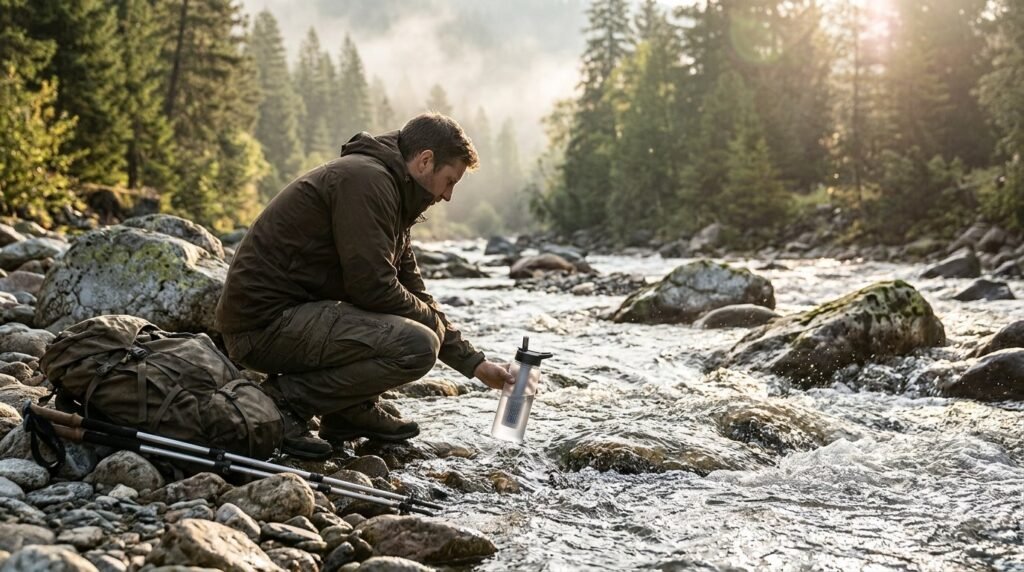
Does a LifeStraw Go filter bottle remove viruses?
No. LifeStraw lists bacteria, parasites and microplastics for the Go, not viruses. For unsafe tap water abroad, you need a purifier like a GRAYL, or a filter plus chlorine.
Keep reading ↓We Checked the Paperwork: Claims vs Certifications
Many bottles say they are “tested to NSF standards.” That is not the same as being certified. Certification means an outside body like NSF or the Water Quality Association (WQA) checked the product and lists it publicly. On November 1, 2026, we searched NSF’s public list of certified drinking water products for every brand below. Here is what we found.
| Bottle | Viruses | Bacteria and parasites | Lead, PFAS, chemicals | Taste and chlorine | Official listing we found |
|---|---|---|---|---|---|
| GRAYL GeoPress / UltraPress | Brand claim | Brand claim | Brand claim | Brand claim | None in NSF’s list. GRAYL says it is lab-tested to the EPA purifier standard and NSF protocols. |
| LifeStraw Go | Not claimed | Brand claim (EPA and NSF P231 for bacteria and parasites) | Not a strength | Carbon filter claim | None in NSF’s list |
| Epic Nalgene OG | Not claimed for this tap version | Not verified | Brand claim | Brand claim | None under the Epic name in NSF’s list |
| Brita filtering bottle | No | No (Brita says it is not made to purify) | Not claimed | Certified (WQA, to NSF/ANSI 42, per Brita’s guide) | WQA certification for chlorine taste and particles |
| Clearly Filtered bottle | Not claimed | Not claimed | “Tested to” NSF 53, 401, 473 | “Tested to” NSF 42 | None in NSF’s list |
What this means for you: the only bottle here with a certification we could confirm is the Brita, and it covers taste and chlorine, not safety from germs. Everything else rests on the brand’s own lab tests. That does not mean the claims are false. It means you are trusting the brand, so pick a brand with a long track record and published test data.
We left Clearly Filtered out of our picks for one reason: when we checked, its bottle listings on the store had mixed ratings from a small number of buyers. Its claims are strong on paper, so it is worth a look if those ratings improve.
The Hidden Cost: How Many Filters You Will Buy Each Year
A cheap bottle can cost more over a year if its filter wears out fast. We used each brand’s own filter life and assumed you drink 1 liter a day from the bottle (about 96 gallons a year).
| Bottle | Filter life (brand figure) | Filters per year at 1 liter a day |
|---|---|---|
| GRAYL GeoPress | 350 presses, about 65 gallons (250 liters), or 3 years | About 1.5 |
| GRAYL UltraPress | About 300 presses, 40 gallons (150 liters) | About 2.5 |
| LifeStraw Go | Membrane about 4,000 liters; carbon filter about 100 liters | About 4 carbon filters; the membrane lasts years |
| Epic Nalgene OG | Up to 75 gallons per filter | About 1.5 |
| Brita filtering bottle | 40 gallons or about 2 months | About 6 (the 2-month limit comes first) |
| Clearly Filtered bottle | 25 gallons or 6 months | About 4 |
For GRAYL, the sign is simple: when a press starts taking about 25 to 30 seconds, it is time for a new cartridge. Before you buy any bottle, check the current price of its replacement filter too, not just the bottle.
The Best Water Filter Bottles, by Job
1. Best for Travel Abroad: GRAYL GeoPress
The GRAYL water bottle works like a French press. You fill the outer cup, push the inner press down, and the cartridge cleans the water in about 8 seconds. GRAYL calls it a purifier and says it removes viruses, bacteria and protozoan cysts, plus some chemicals and heavy metals. It holds 24 oz.
- Why it stands out: it is the only bottle on our list built to handle viruses, which is what matters most with unsafe tap water abroad.
- The catch: it costs more than a simple filter bottle, the cartridge lasts about 65 gallons, and pressing takes some effort. We found no NSF listing, so you are trusting GRAYL’s own lab claims.
- Buyer ratings: 4.6 stars from more than 5,400 ratings when we checked.
2. Lighter Travel Option: GRAYL UltraPress
Same idea, smaller bottle. The UltraPress holds 16.9 oz, so it is easier to carry around a city all day. Retailers like REI list the same virus, bacteria and protozoa protection. Its cartridge is rated for about 40 gallons, so you will replace it more often than the GeoPress.
- Best for: day trips, short city breaks and anyone who wants a lighter bag.
- Buyer ratings: 4.4 stars from about 400 ratings when we checked.
3. Best for Hiking on a Budget: LifeStraw Go
You drink through a straw, and the water passes through a 0.2 micron membrane and a carbon filter on the way. LifeStraw says the membrane stops bacteria, parasites and microplastics, and the carbon improves taste. It is light, simple and much cheaper than a GRAYL.
- Why it stands out: the membrane lasts for years of normal use, and you only swap the small carbon filter.
- The catch: it does not remove viruses, and CNN Underscored’s review notes it is not strong on lead, mercury or PFAS. Use it for streams and lakes, not for unsafe tap water abroad.
- Buyer ratings: 4.4 stars from about 3,700 ratings when we checked.
4. Best for City Tap Water: Epic Nalgene OG
This one is for safe tap water that you still want cleaner. Epic pairs a classic Nalgene bottle with a straw filter and says it targets chlorine, lead, PFAS and other tap water chemicals. Epic rates each filter for up to 75 gallons.
- Why it stands out: long filter life for a tap water bottle, and a tough, simple design.
- The catch: we found no listing under the Epic name in NSF’s database, and this version is not made for viruses. Do not take it abroad as your only protection.
- Buyer ratings: 4.4 stars from about 1,600 ratings when we checked.
5. Cheapest Way to Better Taste: Brita Filtering Bottle
If your tap water is safe and you just dislike the taste or the chlorine smell, this is the simple answer. It is also the only bottle on our list with a certification we could confirm: Brita’s guide says it is WQA-certified to NSF/ANSI 42 for chlorine taste and particles.
- The catch: Brita says plainly that it is not made to purify water. No germ protection, so it is a home and office bottle only.
- Buyer ratings: 4.6 stars from more than 34,000 ratings when we checked.
GRAYL vs LifeStraw: Which One Should You Buy?
People compare these two more than any others, but they are built for different water. Here is the short version.
| GRAYL GeoPress | LifeStraw Go | |
|---|---|---|
| Type | Purifier (press) | Filter (straw) |
| Viruses | Yes (brand claim) | No |
| Bacteria and parasites | Yes (brand claim) | Yes (brand claim) |
| How you drink | Press once, then drink or pour | Sip through the straw |
| Filter life | About 65 gallons | Membrane for years; carbon about 100 liters |
| Best for | Travel abroad, hotel taps | Hikes, camping, budget |
Our take: if you will ever drink tap water in a country where it is not safe, get the GRAYL. If you mostly hike in places where streams are the issue and you want to spend less, the LifeStraw Go is the smarter buy.
Which Water Filter Bottle Do You Need?
Answer three quick questions and we will point you to one bottle.
Which Water Filter Bottle Do You Need?
Picks are based on each maker’s published claims and the official certification lists. We research products; we do not lab-test them.
| Where you fill up | What to use |
|---|---|
| Hotel tap in a country with unsafe water | GRAYL GeoPress or UltraPress, or bottled or boiled water |
| Mountain stream or lake | LifeStraw Go (add chlorine tablets if viruses are a concern) |
| Airport or office fountain at home | Brita or Epic Nalgene OG |
| Old pipes, worried about lead | Epic Nalgene OG, and ask your water utility for a lead test |
Cloudy water needs one extra step with any bottle. The CDC notes that small particles can shield germs, so let silt settle or pour the water through a clean cloth first. Traveling soon? Our gifts for women who travel guide and our hidden camera detector guide cover the rest of your packing list.
You are in a hotel where the tap water is not safe to drink. Which bottle is built for it?
The GRAYL GeoPress. It is a purifier, so it also targets viruses. Brita only improves taste, and the LifeStraw Go stops bacteria and parasites but not viruses.
Keep reading ↓How We Researched This Guide
We do not run a water lab, and we will not pretend we do. Instead, we read each brand’s own claims and filter specs, then checked them against three things: the CDC’s travel guidance on filters and purifiers, NSF’s public list of certified products (searched November 1, 2026), and independent reviews such as CNN Underscored and Water Filter Guru. We also checked that each bottle is easy to buy and has a solid buyer rating. Where a claim is only the brand’s word, our tables say so.
The PrimeDigger Verdict
The best water filter bottle is the one built for your water. For travel abroad, the GRAYL GeoPress is the only bottle here made to handle viruses. For hikes, the LifeStraw Go does the job for less. At home, a Brita or Epic Nalgene OG makes tap water taste better. And whatever you buy, read the label carefully: “tested to NSF standards” is a brand claim, not a certification.
Water Filter Bottle FAQ
Do water filter bottles work?
Yes, for the job they are built for. Most filter bottles stop bacteria and parasites or improve taste. Very few are built to remove viruses, so check whether a bottle is a filter or a purifier before you rely on it abroad.
Do water filter bottles remove viruses?
Most do not. The CDC says travelers should not expect portable microfilters to remove viruses like norovirus. Purifier bottles such as the GRAYL GeoPress are built for viruses, or you can add chlorine tablets to filtered water.
Can I drink tap water abroad with a filter bottle?
Only if the bottle is a purifier, or if you also treat the water with chlorine. A regular filter bottle stops bacteria and parasites but not viruses, which can be a risk in tap water in some countries.
How often should I change the filter?
It depends on the bottle. A GRAYL GeoPress cartridge lasts about 65 gallons, a Brita bottle filter about 40 gallons or 2 months, and the LifeStraw Go carbon filter about 100 liters. Change it sooner if flow slows down.
Is GRAYL better than LifeStraw?
For travel abroad, yes, because GRAYL is a purifier that also targets viruses. For hiking on a budget, the LifeStraw Go is often the better buy because it is lighter and its membrane lasts for years.
Are water filter bottles certified?
Few are. On November 1, 2026 we found no listing in NSF’s public database for GRAYL, LifeStraw, Epic or Clearly Filtered bottles. Brita says its filtering bottle is WQA-certified for chlorine taste and particles.
Sources
- CDC Yellow Book 2024: Water Disinfection
- CDC: Water treatment options when hiking, camping or traveling
- NSF: Certified drinking water treatment units (searched November 1, 2026)
- LifeStraw: The difference between a filter and a purifier
- CNN Underscored: LifeStraw Go review
- REI: GRAYL UltraPress replacement cartridge
- Clearly Filtered: How long the bottle filter lasts
- Water Filter Guru: Clearly Filtered certification notes
- Brita: Filtering bottle user guide
This article is for general information. If you are unsure whether local water is safe, follow local health advice or use bottled or boiled water.