

Menopause supplement marketing is everywhere right now, and if you have scrolled through social media lately, you have probably seen influencers touting creatine as the ultimate midlife miracle powder. The claims are massive: it supposedly melts belly fat, banishes brain fog, and builds invincible bones. But as is so often the case in the wellness industry, the marketing hype is running miles ahead of the science.
So, does creatine actually help with menopause, or is it just another overhyped cash grab? To find out, we ignored the flashy sales pages and went straight to the source. We dug through the actual, peer-reviewed clinical trials evaluating creatine for menopausal women. We looked at the exact dosages they used, the strict timelines they followed, and the specific outcomes they tracked for bone density, muscle mass, and cognitive function.
What we found might surprise you. While the research on creatine for menopausal women shows it is genuinely one of the safest supplements on the planet, its true benefits are highly specific—and almost completely different from what the internet is trying to sell you. Here is exactly what the research says (and doesn’t say) about adding creatine to your routine.
Should Menopausal Women Take Creatine?
Let’s cut straight through the marketing noise: yes, most menopausal women can safely take creatine, but it is not a mandatory silver bullet. If your primary goals are to support your physical strength, combat age-related muscle loss, and give your brain an extra layer of cellular support, creatine is absolutely worth a spot in your daily routine. However, if you are hoping for a magical powder that will miraculously fix your shifting hormones or replace a balanced diet and exercise, you are going to be disappointed.
From a safety perspective, creatine is one of the most thoroughly vetted dietary supplements on the planet. While it is often associated with heavy weightlifting and bodybuilders, the scientific community has spent decades studying its impact on much broader populations, including older adults and postmenopausal women.
The data consistently shows that high-quality creatine is remarkably safe and well-tolerated. It does not alter your body’s estrogen or progesterone levels, it does not cause hormonal fluctuations, and it does not damage healthy kidneys when taken at standard, recommended doses. While you should always consult your primary healthcare provider before adding a new supplement to your regimen—especially if you have a pre-existing renal condition—the overarching consensus in medical literature is clear: for the vast majority of women navigating midlife, the safety profile is incredibly reassuring.
What Happens When a Woman Starts Taking Creatine in Menopause?
If you’re wondering what happens when a female starts taking creatine, the reality is far less dramatic than the marketing claims. While brands might promise rapid body transformations, your body actually goes through a very predictable, physiological adjustment period.
First, let’s talk about the scale. The most immediate physical change you might notice is minor weight fluctuation. During the first two to four weeks of supplementation, it is entirely normal to see the scale jump by one to three pounds (or one to two kilograms). This is where a lot of women panic and throw the tub in the trash, mistaking this shift for rapid fat gain. It isn’t. Creatine works by drawing water directly into your muscle cells to improve their hydration and energy capacity. This intracellular water retention is actually a sign that the supplement is working.
You may also experience a short digestive adjustment period. Some women report mild bloating, an upset stomach, or minor nausea when they first introduce creatine to their system. However, studies show that these side effects are typically temporary and are most often linked to taking too much at once (like during an aggressive “loading phase”) or taking the supplement on an empty stomach.
By setting realistic expectations, you can push through this initial adjustment phase. If you stick with a low, consistent daily dose, the initial water weight stabilizes, any digestive discomfort usually fades, and your body begins utilizing the creatine for what actually matters: protecting your muscle tissue and supporting your brain.
Creatine and Bone Density — What the Two-Year Study Actually Found
If you have seen advertisements pushing creatine for menopausal women, you have almost certainly seen claims that it will “build unbreakable bones” or reverse age-related bone loss. It is an incredibly appealing promise, especially since declining estrogen levels cause bones to gradually become thinner and weaker. Unfortunately, the actual clinical data tells a very different story.
This brings us to the “myth-bust” moment of our research. To see if creatine alone could actually build bone, researchers conducted a massive, two-year randomized controlled trial—often referred to as the Sales et al. study. They tracked 200 postmenopausal women who were already diagnosed with osteopenia (lower-than-normal bone density). Half of the women took 3 grams of creatine monohydrate daily, and the other half took a placebo. Crucially, they did not add a new resistance training routine.
The results after two full years? The women taking creatine saw absolutely no improvement in their bone mineral density compared to the placebo group. Their lumbar spine, femoral neck, and total femur bone density continued to decrease over time at the same rate as the women who took nothing.
This directly contradicts a lot of aggressive supplement marketing. The major takeaway here is that taking a scoop of creatine every morning and going about your normal day will not magically rebuild your skeleton. While creatine can play a supportive role in a broader health protocol, treating it as a standalone cure for bone density loss is not supported by the science.
Creatine and Muscle Mass — Where It Actually Helps
While creatine might not be a magic cure for bone density, there is one area where the benefits of creatine for menopausal women are clear and scientifically backed: preserving and building muscle.
During menopause, the drop in estrogen significantly accelerates the loss of lean muscle mass and physical strength. To see if creatine could help stop this decline, researchers conducted a massive meta-analysis combining data from 7 randomized controlled trials involving 608 postmenopausal women.
The results were incredibly revealing. The women who supplemented with creatine saw a modest, but statistically significant, gain in lean muscle mass compared to those who took a placebo. However, there is a crucial catch that most supplement companies conveniently leave out: the creatine only worked effectively when it was paired with a resistance training program. Women who simply took creatine and remained sedentary saw almost no measurable improvement in their muscle mass or strength.
The Practical Takeaway: Creatine is a powerful tool, but it is not a replacement for doing the physical work. If you want to see the real benefits of creatine for menopausal women, you must combine it with a consistent strength training routine. Lifting weights provides the stimulus your muscles need to grow, and the creatine provides the cellular energy to help you lift heavier, recover faster, and build that lean tissue back. Creatine plus strength training is the winning formula—not creatine alone.
Creatine for Perimenopause Brain Fog — The New Research
Of all the symptoms women experience during the menopause transition, brain fog is often the most frustrating. If you find yourself forgetting words mid-sentence, losing focus, or feeling a general mental haze, you are not imagining it. As estrogen levels decline, the brain’s energy metabolism shifts, making it harder for your neurons to maintain peak efficiency.
This is where the newest, most exciting research on creatine is emerging. Because the brain relies on creatine for quick cellular energy just like your muscles do, scientists recently asked a fascinating question: could a small daily dose clear the fog?
To find out, researchers conducted the 2025 CONCRET-MENOPA trial, a randomized controlled study that specifically tested creatine supplementation in 36 perimenopausal and menopausal women. For eight weeks, the women took varying low doses of highly soluble creatine hydrochloride (HCl) or a placebo.
The results were incredibly promising. The women taking a 1,500 mg daily dose of creatine HCl saw their reaction times improve significantly compared to the placebo group. Furthermore, brain scans showed a noticeable increase in creatine levels right in the frontal lobe—the part of the brain responsible for focus, decision-making, and working memory.
The Reality Check: While these cognitive outcomes are fantastic, we need to stay intellectually honest. This was a single, small trial involving only 36 women. It measured reaction speed, not necessarily memory recall, and the science is still in its early stages.
The CONCRET-MENOPA trial is an encouraging signal that creatine can support brain energy during midlife hormonal shifts, but it is not yet “settled science”. Furthermore, brain fog rarely happens in a vacuum—it is heavily exacerbated by the sleep disruptions and anxiety that characterize the transition into menopause. If you are trying to clear the mental haze, it is equally important to audit your sleep hygiene. Before loading up on sleep aids, make sure you aren’t accidentally taking a melatonin dosage that is too high, and take a critical look at whether popular stress relief products actually deliver on their promises to calm a racing mind.
Creatine Dosage for Menopausal Women
When it comes to taking creatine monohydrate for menopausal women, more is not necessarily better. The dosages used in the clinical trials are actually quite modest, which is great news if you are worried about stomach upset or side effects.
Looking across the research, the effective dosages varied slightly depending on the specific goal and the type of creatine used. In the bone density and muscle mass studies, researchers primarily used a standard dose of 3 grams per day of creatine monohydrate. For cognitive benefits and brain fog, the recent trials utilized highly soluble creatine hydrochloride (HCl) at doses ranging from 750 mg to 1,500 mg per day.
You might see fitness influencers talking about a “loading phase”—where you take 20 grams a day for a week to saturate your muscles quickly. You do not need to do this. For menopausal women, skipping the loading phase and simply taking a consistent, low daily dose (3 to 5 grams of monohydrate) is the best approach. It achieves the exact same cellular saturation over a period of three to four weeks, while completely bypassing the intense bloating and water retention that often accompanies heavy loading.
Best Creatine for Women in Menopause
If you have decided that the research makes it worth giving a try, your next step is picking the right product. The supplement market is full of overpriced products featuring “for women” labels that simply add pink packaging and a 30% price markup. You do not need a specialized blend—you just need clean, high-quality, third-party tested ingredients.
Here are the top options based on what the actual clinical trials used:
- The Gold Standard Powder: For the pure, unflavored powder used in almost all the foundational muscle and bone research, the BulkSupplements.com Creatine Monohydrate Powder is an exceptional choice. It is micronized for easier mixing, completely unflavored, and pure, making it seamless to throw into your morning tea, coffee, or smoothie without any gritty texture.
- The Convenient Pill Alternative: If you absolutely hate mixing powders or find yourself traveling frequently, you can get the exact same high-quality ingredient in capsule form. The BulkSupplements.com Creatine Monohydrate Capsules offer a clean, gluten-free, 5000mg serving size per day without requiring a shaker cup.
No matter which form you prefer, sticking to pure monohydrate ensures you are getting the exact compound backed by decades of safety data.
Does Creatine Help With Menopause Belly Fat?
If you are typing “does creatine help with menopause belly fat” into a search engine, you are certainly not alone. It is one of the most frequently asked questions about this supplement. But let’s be completely transparent: there is zero direct clinical evidence that taking creatine will cause you to directly lose visceral belly fat.
Many supplement brands intentionally conflate “building lean mass” with “burning fat” to sell you products. While it is true that building more muscle can slightly increase your resting metabolic rate over time, creatine itself is not a fat burner. Managing midlife body composition requires a holistic approach to nutrition. If you are adjusting your diet to support your fitness goals, clearing up the confusion around dietary fats is a crucial first step—make sure to read our healthy cooking oil guide to ensure you are fueling your body with the right anti-inflammatory options.
If your primary goal is to manage the broader hormonal shifts of menopause—like hot flashes, mood swings, or weight distribution changes—you are looking in the wrong supplement category. For those specific symptom-management goals, you would want to explore a dedicated hormone-support blend rather than a muscle-hydration powder. For instance, options like the Clean Nutra Menopause Supplements combine targeted herbal ingredients (like Chasteberry, Black Cohosh, and wild yam) with magnesium and B6 to support overall hormonal balance. It is crucial to separate these different tools: use creatine to protect your muscles, and use targeted herbal or medical interventions to manage your estrogen fluctuations.
The Bottom Line
So, does creatine for menopausal women actually live up to the hype? The honest, evidence-based answer is a highly qualified yes.
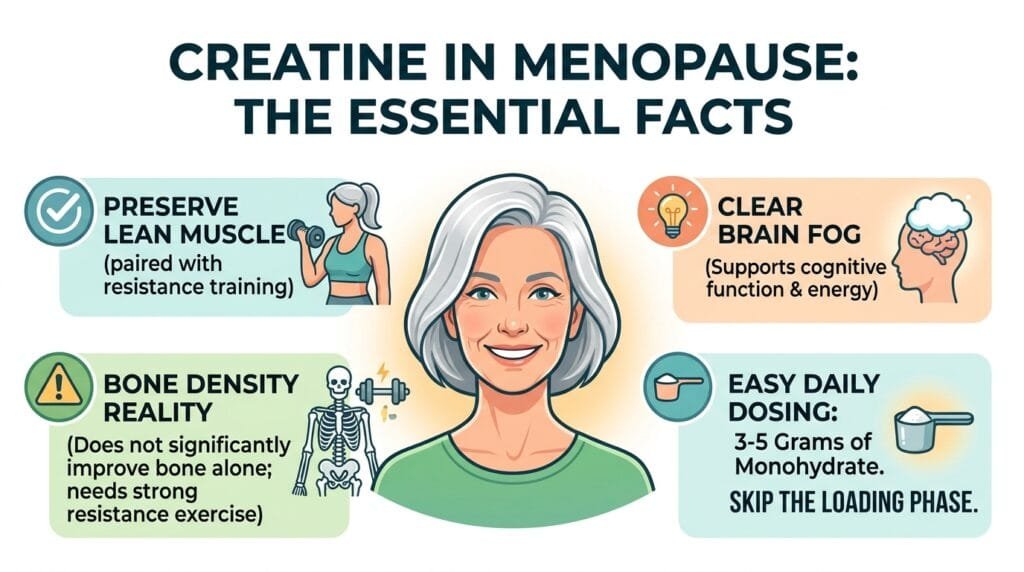
Creatine is not going to magically cure your hot flashes, melt away menopause belly fat, or rebuild your skeleton if you are completely sedentary. But if you are willing to put in the physical work, it is arguably the most effective, research-backed tool you can buy to protect your lean muscle mass and keep your physical strength intact as your estrogen drops. Add in the emerging research suggesting it might help clear the dreaded midlife brain fog, and a low, consistent daily dose of creatine becomes a very compelling addition to your wellness routine.
Creatine is one of 13 supplement categories we investigated the same way for The Supplement Scam Bible — including the “advanced” creatine forms quietly costing you more for nothing. Take a look →
If you want to keep optimizing your health tracking and separate wellness facts from corporate marketing, dive into our expose on the top 7 sleep industry myths and wellness apps next.
When should a 50-year-old woman take creatine?
Timing matters less than consistency. The clinical trials didn’t find a meaningful difference between taking it before or after a workout — what mattered was taking it daily. Pick a time you’ll actually remember, with or without food, and stick with it.
What are the side effects of creatine for women?
Most side effects are mild and temporary: a small water-weight increase (1-3 lbs) in the first few weeks, and occasional bloating if taken on an empty stomach or during an aggressive loading phase. At standard doses, the research doesn’t show hormonal disruption or kidney damage in otherwise healthy women.
What are the pros and cons of creatine for menopausal women?
The pros: it’s one of the most thoroughly studied, safest supplements available, it modestly preserves lean muscle when paired with resistance training, and early research suggests real cognitive benefits. The cons: it doesn’t build bone density on its own, it isn’t a fat burner, and it doesn’t do much of anything if you stay sedentary.
Is there research on creatine specifically for perimenopause?
Yes — the 2025 CONCRET-MENOPA trial tested low-dose creatine HCl in perimenopausal and menopausal women and found improved reaction times and increased brain creatine levels after eight weeks. It’s a small, early study, but it’s currently the most direct evidence available on this specific question.