
Reader-supported: we may earn a commission from links on this page.
Quick answer: Yes, a Wi-Fi doorbell camera can be knocked offline. Police in Los Angeles and New Jersey have warned that burglars are using Wi-Fi jammers to cut cameras and alarms before breaking in. Jamming is illegal in the US, but the devices are easy to find online. The reliable fix is a doorbell that doesn’t use Wi-Fi at all: a PoE (Power over Ethernet) doorbell, which gets power and data through one network cable. Our top pick is the Reolink Video Doorbell PoE, which records locally with no monthly fee.
We went through police reports, FCC rules and security research to see how real the threat is, what actually stops it, and which doorbell cameras work without Wi-Fi.
Table of Contents
Can Burglars Really Jam a Doorbell Camera?
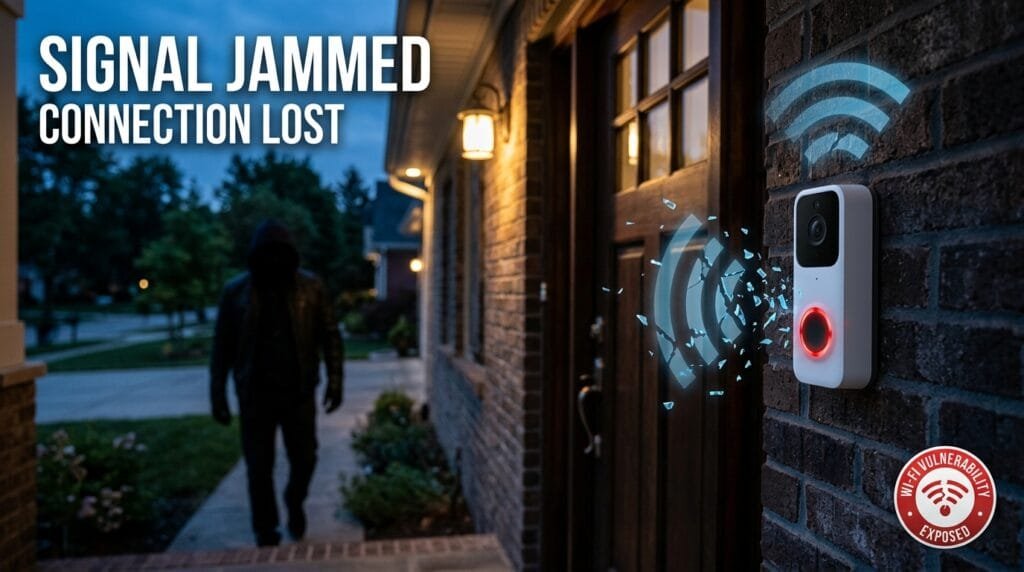
Yes, and it’s no longer just a theory. In March 2025, the LAPD warned that burglars in Los Angeles were using Wi-Fi jammers to break into homes, with Chief Jim McDonnell calling them “a universal key.” In June 2024, police in Florham Park, New Jersey, reported a homeowner who watched an intruder on his camera until the feed cut out, and warned that jammers can also block Wi-Fi calling to 911.
Most break-ins still don’t involve any tech at all. But if your doorbell, cameras and alarm all depend on Wi-Fi, one cheap device can silence all of them at once.
Jamming vs. Deauth: Two Ways to Knock a Camera Offline
| Method | How it works | What stops it |
|---|---|---|
| Radio jamming | Floods the Wi-Fi frequencies with noise so nothing can get through | Only a wired connection |
| Deauth attack | Sends fake “disconnect” messages to your camera over and over | Partly: WPA3 with protected management frames. Fully: a wired connection |
Both end the same way: your doorbell drops off the network, can’t send an alert, and a cloud-only camera can’t save the clip.
Are Wi-Fi Jammers Legal?
No. The FCC says using, selling or marketing a jammer in the US is illegal and can lead to large fines, seized equipment and even prison (see the FCC jammer enforcement page). Deauth tools are not a legal loophole either. In a 2015 enforcement advisory, the FCC said deliberately blocking Wi-Fi is prohibited, after fining Marriott $600,000 for using deauthentication to knock guests’ hotspots offline.
The problem is enforcement. These devices are small, sold online, and used by people who are already breaking the law. So the practical defense falls on the homeowner.
Why Most Wired Doorbells Can Still Be Jammed
When a doorbell box says “wired,” it usually means the power comes from your old doorbell wires. The video still travels over Wi-Fi. Constant power doesn’t help if the data connection is cut. To be safe from jamming, both power and video need to run through a cable.
The Fix: A PoE Doorbell Camera Without Wi-Fi
A PoE doorbell connects to your router or network switch with a single Ethernet cable that carries both power and data. There’s no radio signal to jam. Good PoE models also save video on a memory card or recorder inside your home, so footage is kept even if your internet goes down.
What you need: an Ethernet cable run to your front door, plus a PoE switch or a small PoE injector near your router. If you’re not comfortable running cable, an electrician or low-voltage installer can do it.
| Doorbell | Wi-Fi? | Storage | Monthly fee | Best for |
|---|---|---|---|---|
| Reolink Video Doorbell PoE | No | microSD (up to 512GB), Reolink NVR, FTP/NAS | None required | Most homes |
| Ring Wired Doorbell 4K Elite | No (native PoE) | Ring cloud | Ring subscription for most recording features | Existing Ring users |
| UniFi G4 Doorbell Pro PoE | No | UniFi console running Protect | None | UniFi networks |
Best Overall: Reolink Video Doorbell PoE
Check the current price of the Reolink Video Doorbell PoE
This is the most popular true PoE doorbell we found, with thousands of buyer ratings. It records 2K video with a tall 4:3 view, so you see visitors head to toe and packages on the ground. According to Reolink, there’s no monthly fee, recordings go to a microSD card (up to 512GB, not included), a Reolink NVR or FTP/NAS, and an internet outage won’t stop local recording. A plug-in chime is included.
Things to know: it has no Wi-Fi at all, it doesn’t work with third-party NVRs, and the PoE injector or switch is not included.
For Ring Users: Ring Wired Doorbell 4K Elite
Check the current price of the Ring Wired Doorbell 4K Elite
Ring’s top doorbell runs on native PoE, so it doesn’t rely on Wi-Fi for video. It adds 4K video and up to 10x zoom. The catch: footage goes to Ring’s cloud, so it still needs your internet connection, and most recording features need a Ring subscription. It’s also a new model with few reviews so far. Choose it if you already use Ring and want to keep everything in one app.
For UniFi Networks: UniFi G4 Doorbell Pro PoE
If your home already runs on Ubiquiti UniFi gear, the G4 Doorbell Pro PoE has a 2MP main camera plus a second 2MP camera pointing down at packages. It’s wired-only and needs a UniFi console running UniFi Protect, which stores the video in your home. It’s not a good choice if you don’t already own UniFi equipment.
What You Need to Power It: A PoE Injector
If your router doesn’t supply PoE (most home routers don’t), a small injector adds it. The TP-Link POE150S injector supplies standard 802.3af PoE up to 15.4W, which the Reolink doorbell supports. Check your doorbell’s power needs before buying.
Stuck With a Wi-Fi Doorbell? What Helps
- Turn on WPA3 if both your router and camera support it. WPA3 uses protected management frames, which block most fake disconnect messages. It’s not perfect: a 2022 study found ways around these protections on several platforms, and it does nothing against real radio jamming.
- Use local storage. A doorbell that also records to a memory card can keep footage of what happened before the signal dropped.
- Hardwire the alarm. Police in both cases above recommended hardwired alarm systems over wireless ones.
- Watch for offline alerts. If your camera app warns you when a device goes offline, keep that on. A sudden drop is worth checking.
- Don’t skip the basics. The LAPD also advised good outdoor lighting and neighbors who look out for each other.
A strong Wi-Fi password or a VPN won’t stop jamming, because the attack happens at the radio level before any password comes into play.
The PrimeDigger Verdict
Wi-Fi jammers are illegal, but police reports show they’re being used. If your front door camera matters to you, the only setup that can’t be jammed is a wired one. For most homes, the Reolink Video Doorbell PoE is the simplest choice: one cable, no Wi-Fi, local recording and no monthly fee.
Worried about other hidden tech? Read our guides on how to find hidden cameras and how to find a tracker on your car.
Want the deeper investigation? Our ebook The Hidden Surveillance Bible covers hidden cameras, GPS trackers and other surveillance devices, how they work, and how to find them. Get the ebook ($19) → See all our ebooks →
Frequently Asked Questions
Can a Wi-Fi jammer stop a doorbell camera?
Yes. A jammer or deauth device can disconnect a Wi-Fi doorbell from your network so it cannot send alerts or upload video. Police in Los Angeles (2025) and New Jersey (2024) have warned about burglars using them. A wired PoE doorbell is not affected.
Are Wi-Fi jammers legal in the US?
No. The FCC prohibits using, selling or marketing jammers, and it has said deliberately blocking Wi-Fi, including with deauthentication, is illegal. It fined Marriott $600,000 for blocking guest hotspots.
Can a strong Wi-Fi password or a VPN protect my doorbell from being jammed?
No. Jamming works at the radio level, before passwords or encryption matter. WPA3 with protected management frames helps against fake disconnect messages, but not against real jamming.
What is a PoE doorbell?
A PoE (Power over Ethernet) doorbell gets power and its network connection through one Ethernet cable, so it does not use Wi-Fi. You need a cable run to the door and a PoE switch or injector.
Is there a doorbell camera with no subscription?
Yes. The Reolink Video Doorbell PoE records to a microSD card or a Reolink recorder with no monthly fee. Ring models need a subscription for most recording features.
Sources
- NBC Los Angeles (March 2025): Burglars are using WiFi jammers to break into homes
- FOX 5 New York (June 2024): NJ police warning, burglars using Wi-Fi jammers
- FCC: Jammer Enforcement
- FCC Enforcement Advisory 2015-01: Wi-Fi Blocking is Prohibited
- Schepers, Ranganathan and Vanhoef (2022), ACM WiSec: On the Robustness of Wi-Fi Deauthentication Countermeasures
- Ubiquiti: UniFi G4 Doorbell Pro PoE Kit tech specs