Reader-supported: we may earn a commission from links on this page.
Table of Contents
The Short Answer
Red light therapy devices do work, but only for specific, well-researched uses. The evidence is fairly good for skin aging, moderate for muscle recovery and joint pain, promising for hair loss, and weak for depression. If a product claims to fix everything from wrinkles to depression to hair loss, that is a marketing claim, not a medical one. We reviewed the peer-reviewed research to sort out which claims actually hold up.
What Is Red Light Therapy and How Does It Actually Work?
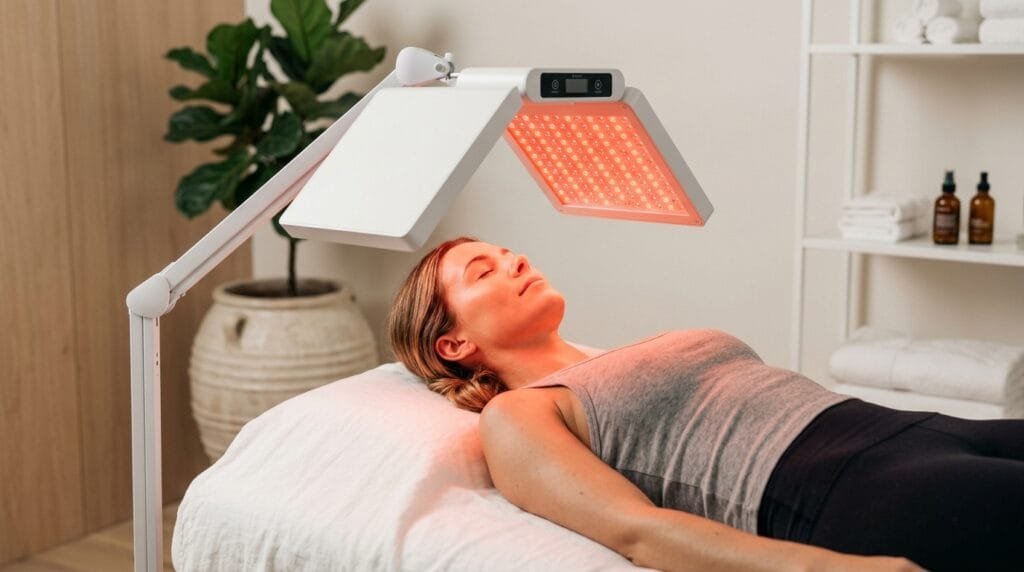
Red light therapy (RLT), also called photobiomodulation or low-level laser therapy (LLLT), uses specific wavelengths of red and near-infrared light to reach into the skin and stimulate biological processes at the cellular level.
The key wavelengths are:
- Red light (630–700 nm): Reaches the surface layers of skin, targets skin cells and collagen production
- Near-infrared light (700–1100 nm): Reaches deeper into muscle tissue and joints
The leading theory is that this light is absorbed by the mitochondria, the energy-producing parts of your cells, helping them produce more ATP, the molecule cells use for energy. More energy may help cells repair themselves and reduce inflammation.
Interest grew after NASA-funded research in the 1990s used LEDs to grow plants in space, which led researchers to test the same lights on human tissue and wound healing.
What the Science Actually Supports
This is where most red light therapy articles go wrong. They either dismiss the entire technology or treat it like a miracle cure. The reality is more nuanced.
1. Skin Health and Anti-Aging: Good Evidence
This is the best-supported consumer use. A 2014 controlled trial in Photomedicine and Laser Surgery found that people treated with red or near-infrared light over 30 sessions had significantly improved skin complexion, skin roughness and collagen density compared with a control group.
The likely reason is that red light stimulates fibroblasts, the skin cells that make collagen and elastin. Results in studies are real but modest, and they need weeks of regular sessions.
Verdict: Real, modest results for skin aging with consistent use.
2. Muscle Recovery and Athletic Performance: Moderate Evidence
A 2015 systematic review in Lasers in Medical Science looked at 13 good-quality randomized trials and found that 10 reported better exercise performance, mostly when light was applied before exercise. Results depended on the dose and wavelength used.
Most of these trials were small and used lasers or clinical LED arrays with carefully controlled doses, so home panels may not match their results.
Verdict: A reasonable recovery tool, especially used before training, but studies are small and doses vary.
3. Joint Pain and Inflammation: Moderate Evidence
A 2005 Cochrane review of five placebo-controlled trials in rheumatoid arthritis found that low-level laser therapy reduced pain and morning stiffness in the short term. The reviewers said it could be considered for short-term relief, but noted the trials were small and used very different devices and settings.
Verdict: May help with short-term joint pain relief. Talk to your doctor if you have arthritis.
4. Hair Loss: Promising Evidence
Several studies support red light devices (mostly laser caps, combs and helmets) for androgenetic alopecia, the most common form of hair loss, and the FDA has cleared several of these devices.
In a 2013 study in Lasers in Surgery and Medicine, men using a 655 nm red light device for 16 weeks had a 39% increase in hair counts compared with a sham device group. The study was small (41 men finished it).
Verdict: Real evidence exists, but results are modest and need months of consistent use. Body panels are not the same as dedicated hair devices.
5. Wound Healing: Promising but Mixed
Light therapy has been studied for wounds, burns and diabetic ulcers for decades, and some clinics use it. But results are mixed and depend heavily on the device and dose. Wounds, especially diabetic ulcers, need medical care, not a home panel.
Verdict: A medical-setting tool, not a reason to buy a home device.
6. Depression and Mental Health: Weak Evidence
Several companies market red light therapy panels as a treatment for depression, seasonal affective disorder (SAD), and anxiety. The evidence here is thin. Most studies are small, poorly controlled, and have not been replicated. Do not buy a red light therapy device primarily for mental health. Talk to a qualified mental health professional instead.
Verdict: Not supported by strong evidence. Do not rely on this.
What Does NOT Matter (But Companies Sell As If It Does)
Irradiance numbers without context: Companies advertise “100 mW/cm²” irradiance as if higher always means better. What actually matters is the total dose delivered to tissue (measured in joules per square centimeter), which depends on irradiance AND treatment time AND distance from the device.
LED count: More LEDs in a panel does not automatically mean more effective treatment. Wavelength accuracy and even output across the panel matter more.
How bright it looks: Near-infrared light is invisible to the human eye. A panel that appears dim is not necessarily less effective than one that glows brightly red.
The 3 Red Light Therapy Devices We Investigated
Value Pick: BestQool Red Light Therapy Pad
Price tier: Budget. A flexible red and near-infrared pad you can wrap around a knee, shoulder or back. It’s the simplest way to try red light therapy on one area without buying a full panel. Check the current price before you buy.
Check the current price of the BestQool Red Light Therapy Pad
Mid-Range Pick: BestQool Red Light Therapy Panel
Price tier: Mid-range. A panel with four wavelengths for face and body, for people who want a bigger treatment area than a pad. Good for regular skin and recovery use.
Check the current price of the BestQool Red Light Therapy Panel
Full Body Pick: Hooga Red Light Therapy Panel
Price tier: Premium. A large panel with 630, 660, 810 and 850 nm wavelengths, so you can treat a big area at once instead of moving a small device around. It’s the biggest commitment of the three, so it’s worth it only if you plan to use red light therapy long term.
Check the current price of the Hooga Red Light Therapy Panel
How to Use Red Light Therapy Correctly
Many people who see no results are using their device too briefly, too rarely, or not for long enough. Some practical guidance:
Follow the maker’s distance and time settings. Light therapy has what researchers call a biphasic dose response: too little light does nothing, and too much can reduce the effect. More is not better.
Be consistent. Most studies used several sessions a week for weeks or months. The skin trial above used 30 sessions, and the hair study ran 16 weeks.
Protect your eyes. Don’t stare into the panel. Close your eyes or use the goggles that come with the device, especially for face treatments.
PrimeDigger Final Verdict
Red light therapy is not snake oil, but it is not a cure-all either. The evidence is best for skin aging, decent for muscle recovery and short-term joint pain, and promising for hair loss. It does not support using red light as a treatment for depression or chronic disease.
The biggest risk when buying is not the technology itself. It is buying a cheap device with inaccurate wavelengths or weak, uneven output. Stick to brands that publish their wavelengths and irradiance.
Our recommendation: If you are interested in skin health or recovery, start with a mid-range panel from a brand that publishes its wavelengths and irradiance. Skip the cheapest no-name devices, and only move to a large full-body panel if you know you will use it regularly. Check the current price of each before you buy.
Curious about hair? Read our research on what causes gray hair and whether it can be reversed.
Want the deeper investigation? Our ebook The Wearable Scam Bible looks at fitness trackers, recovery scores and the subscription traps built into modern wellness gadgets. Get the ebook ($19) → See all our ebooks →
Sources
- Wunsch and Matuschka (2014), Photomedicine and Laser Surgery: A controlled trial of red and near-infrared light treatment for skin
- Vanin, Leal-Junior et al. (2015), Lasers in Medical Science: Phototherapy and exercise performance and recovery, systematic review
- Brosseau et al. (2005), Cochrane Database of Systematic Reviews: Low level laser therapy for treating rheumatoid arthritis
- Lanzafame et al. (2013), Lasers in Surgery and Medicine: The growth of human scalp hair mediated by red light in males
- Huang et al. (2009), Dose-Response: Biphasic dose response in low level light therapy
Frequently Asked Questions
How long does it take to see results from red light therapy?
It depends on what you are treating. In the studies we reviewed, skin improvements came after about 30 sessions, and hair growth was measured after 16 weeks. Expect weeks to months of consistent use, not overnight results.
What is the difference between red light and near-infrared (NIR) light?
Red light (around 630 to 660 nm) is visible and mainly reaches the outer layers of skin, so it is used for skin and collagen. Near-infrared light (around 810 to 850 nm) is invisible and reaches deeper tissue, so it is used for muscles and joints.
Can you use red light therapy every single day?
Follow your device instructions. Light therapy has a biphasic dose response, meaning too much light can reduce the benefit, so longer or more frequent sessions are not automatically better.
Do red light therapy devices damage your eyes?
Consumer panels are much weaker than medical lasers, but you should not stare into them. Close your eyes or wear the goggles provided, especially during face treatments.
This article is for general information, not medical advice. If you have a health condition or take medication, talk to your doctor first. Read our Health Disclaimer.