
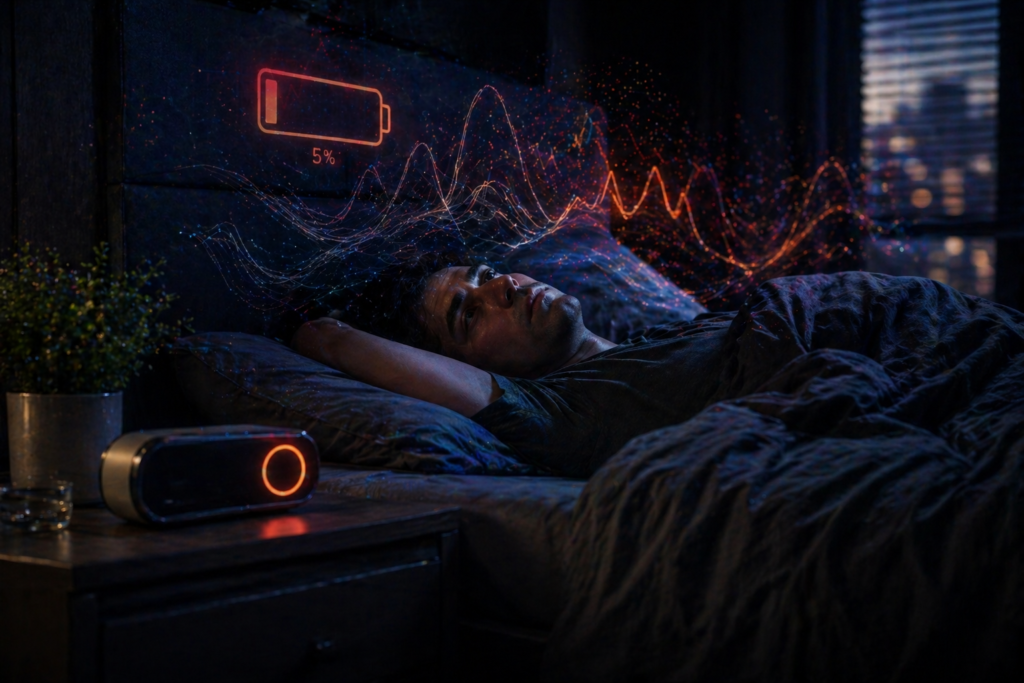
If you find yourself constantly asking, why am i still tired after 8 hours of sleep, you are experiencing the most frustrating biological paradox. You do everything right, stay in bed all night, yet wake up feeling like you barely slept. You are likely suffering from a microscopic deficiency that the standard medical system often overlooks.
At PrimeDigger, we look past the generic advice of “drink more water” and “reduce screen time.” We investigated the biochemical architecture of sleep to expose why millions of people are sleeping for eight hours but getting zero actual rest.
The Architecture of Sleep: It Is Not Just About Time
Being unconscious is not the same as resting. Your brain requires a very specific sequence of REM (Rapid Eye Movement) and Deep Sleep (Slow-Wave Sleep) cycles to repair cellular damage and clear neurotoxins.
If your central nervous system is trapped in a state of high alert, you will spend all eight hours hovering in “Light Sleep.” You are technically asleep, but your brain is never entering the biological repair shop.
The primary switch that transitions your body from a stressed, sympathetic state (“fight or flight”) to a restful, parasympathetic state (“rest and digest”) is a single mineral: Magnesium.
The Great Supplement Scam: Oxide vs. Glycinate
Clinical data shows that up to 75% of adults are deficient in magnesium due to depleted soil quality in modern agriculture. Without it, your brain literally cannot shut off its stress receptors.
But here is where the $30 billion supplement industry takes advantage of exhausted consumers:
- The Cheap Scam (Magnesium Oxide): If you buy a generic magnesium supplement from a grocery store, turn it around and look at the ingredient label. It is almost certainly Magnesium Oxide. Clinical studies prove that the human body can only absorb about 4% of Magnesium Oxide. The rest simply passes through your digestive tract. You are buying an absolute placebo.
- The Biohacker Reality (Magnesium Glycinate or Threonate): To actually impact your sleep architecture, the mineral must cross the blood-brain barrier. Magnesium bound to the amino acid glycine (Magnesium Glycinate) is highly bioavailable, directly lowering core body temperature and relaxing the central nervous system.
The PrimeDigger Verdict : Why Am I Still Tired After 8 Hours of Sleep?
If you want to know why am I still tired after 8 hours of sleep, start by auditing your biochemical baseline. Stop buying cheap grocery store vitamins that your body cannot absorb. Upgrade to a clinical-grade Magnesium Glycinate supplement, take it 45 minutes before bed, and watch your deep sleep metrics transform.
Are you unknowingly destroying your sleep architecture by trying to survive on extreme sleep restriction? Read our latest clinical breakdown: 3 Hours of Sleep Effects: 5 Worst Health Risks Investigated.
Frequently Asked Questions About Poor Sleep Quality
Exactly why am I still tired after 8 hours of sleep even with a good mattress?
Your mattress only supports your musculoskeletal system; it does not regulate your central nervous system. If your brain is locked in a state of sympathetic arousal due to mineral deficiencies (like magnesium), heavy blue light exposure, or late-night cortisol spikes, you will never enter the deep delta-wave sleep required for true rest. You are physically resting, but neurologically awake.
Does waking up in the middle of the night ruin the 8 hours?
It depends on the disruption. Brief awakenings are natural between sleep cycles. However, if you wake up and your brain immediately starts racing from stress, your cortisol spikes. It can take over an hour to clear that cortisol and re-enter a deep sleep phase, meaning your “8 hours” in bed might only contain 4 hours of actual restorative sleep.
Can sleep apnea cause you to be exhausted after sleeping all night?
Yes. Obstructive sleep apnea causes you to stop breathing momentarily, forcing your brain to wake you up slightly to gasp for air. This can happen dozens of times an hour without you consciously remembering it. It completely shatters your sleep architecture, keeping you trapped in light sleep all night despite being in bed for eight hours.