
Reader-supported: we may earn a commission from links on this page.
Quick answer: The cooling products that actually work are the ones that either remove heat from the room (a real air conditioner) or help your body lose heat (a fan plus wet skin, a damp cooling towel). Fans are safe and useful up to about 100°F (38°C) for most healthy people. Swamp coolers only work well in dry climates. Neck coolers make you feel cooler, but they don’t lower your core temperature much, so don’t let them fool you on a dangerous day.
Heat is a real health risk, not just discomfort. In England, the UK Health Security Agency estimated 2,985 heat-associated deaths in the summer of 2022, the highest since records began. We went through the research on fans, neck coolers, evaporative coolers and window films to see what’s worth buying in the US and the UK, and what’s just marketing.
Table of Contents
What Works at a Glance
| Product | What it really does | Best for |
|---|---|---|
| Air conditioner (portable or window) | Removes heat and humidity from the room | Bedrooms and extreme heat |
| Fan + wet skin | Helps sweat evaporate; safe up to about 100°F (38°C) for most people | Most hot days, low cost |
| Cooling towel | Cools the skin as water evaporates | Outdoors, commuting, exercise |
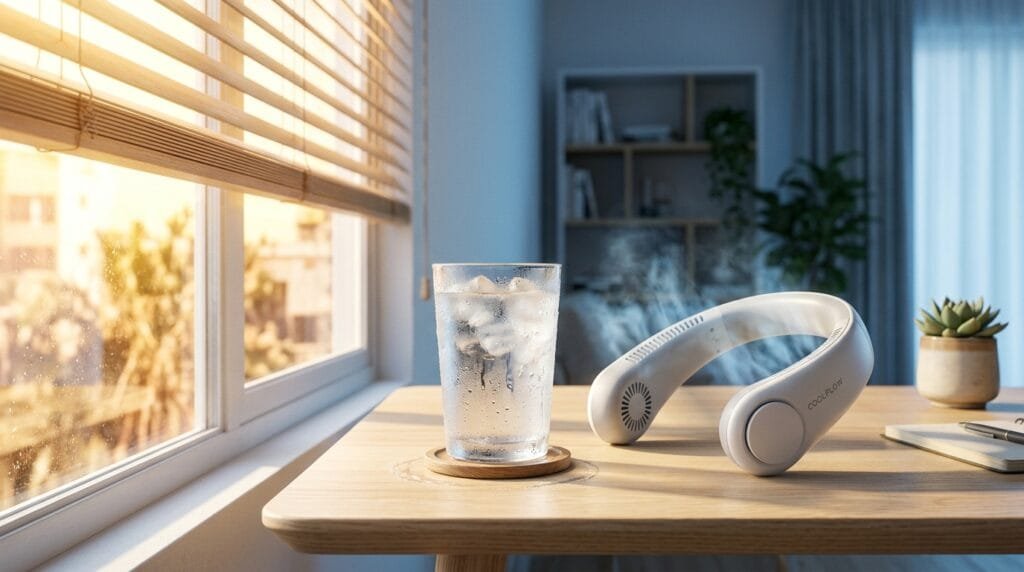
| Neck fan | Moves air around your face and neck | Comfort while moving around |
| Cooling-plate neck fan | Chills a small metal plate on your neck | Comfort, short bursts |
| PCM neck wrap | Absorbs heat at about 64°F (18°C) for a while | Comfort without condensation |
| Swamp (evaporative) cooler | Adds moisture to cool the air | Dry climates only |
| Reflective window film | Blocks some sun heat coming in | Sunny, south or west-facing windows |
Do Fans Actually Cool You Down?
Yes, more than many heatwave articles suggest. A 2021 study in The Lancet Planetary Health modeled fan use across hot weather days and found fans would have been helpful on about 95% of them. The researchers proposed simple limits: fans help below about 102°F (39°C) for healthy young adults, 100°F (38°C) for healthy older adults, and 99°F (37°C) for older adults on certain medications. The NHS gives a more cautious limit of 35°C (95°F).
Above those temperatures, a fan blowing very hot air can add heat instead of removing it. That’s when you need real air conditioning or a cooler place to go. A simple trick that helps: wet your skin or clothes with cool water and sit in front of the fan.
Do Neck Fans and Neck Coolers Work?
They make you feel better, but be careful about what that means. In a 2011 study, runners wearing a cooling collar lasted 13.5% longer in the heat. But they stopped at the same level of discomfort, while their core temperature had climbed higher than without the collar. In other words, cooling the neck tricked the brain into feeling cooler while the body kept heating up.
That doesn’t make neck coolers useless. For commuting, waiting outdoors or working at a stuffy desk, they’re a real comfort upgrade. Just don’t use one as a reason to push through dangerous heat, especially for older adults or anyone exercising.
Do Swamp Coolers (Evaporative Coolers) Work?
Only in dry heat. A swamp cooler blows air over wet pads, which cools the air by adding moisture. The US Department of Energy says they can be a cost-effective option in arid climates. In humid places, like most of the eastern US and the UK, the air is already damp, so they cool much less and can make a room feel muggy. Small “mini air coolers” and misting fans sold as “portable air conditioners” work the same way. They are not air conditioners.
Cooling Products That Actually Work
Best for Bedrooms: BLACK+DECKER 14,000 BTU Portable Air Conditioner
Check the current price of the BLACK+DECKER Portable Air Conditioner
A real air conditioner is the only product here that actually lowers the temperature and humidity of a room. This one is a well-known model with thousands of buyer ratings. The listing rates it at 14,000 BTU (10,200 BTU under the newer SACC standard, which is closer to real-world cooling) for rooms up to 700 sq ft, and it also works as a heater, dehumidifier and fan. It needs its exhaust hose vented out a window. Ratings are mixed (around 4 stars), so read recent reviews before buying.
Best Budget Pick: FROGG TOGGS Chilly Pad Cooling Towel
Check the current price of the FROGG TOGGS Chilly Pad
Wet it, wring it and drape it on your neck or head. It works the same way sweat does: as water evaporates, it pulls heat from your skin. It’s cheap, needs no battery and has thousands of strong ratings. Like all evaporative products, it works best in dry heat and with a breeze.
Best Neck Fan: JISULIFE Portable Neck Fan
Check the current price of the JISULIFE Neck Fan
A simple bladeless neck fan with 5 speeds and a 4,000 mAh battery, and one of the most-reviewed neck fans you can buy. It moves air; it doesn’t chill it. That’s fine on warm days, and it pairs well with a damp cooling towel.
Upgrade Pick: TORRAS COOLiFY Air Neck Fan
Check the current price of the TORRAS COOLiFY Air
This type of neck fan adds a small electronic cooling plate (often called a semiconductor or Peltier plate) that feels cold against your neck. It’s a stronger comfort effect than a plain fan, but the same caution applies: feeling cool isn’t the same as lowering your core temperature. Battery life is shorter when the cooling plate is on.
No-Battery Pick: PCM Neck Cooling Wrap
Check the current price of the PCM Neck Cooling Wrap
Phase change material (PCM) wraps are made to freeze at about 64°F (18°C), so they set in a fridge or cool room and stay cold without being painfully icy or dripping with condensation like an ice pack. They stay cold for a limited time before they need to recharge.
For Sunny Windows: Volcanics Reflective Window Film
Check the current price of the Volcanics Window Film
A silver, reflective static-cling film that bounces back some of the sun’s heat and adds daytime privacy. It’s renter-friendly with no adhesive. It helps most on windows that get direct afternoon sun. Note it becomes see-through at night when your lights are on.
How to Stay Cool Without AC (Free Tips)
- Close curtains and windows during the day and open them at night when it’s cooler outside, as the NHS advises.
- Wet your skin and use a fan. A cool shower, a damp towel or spraying water on your arms all help your body shed heat.
- Drink regularly and limit alcohol.
- Find the coolest room to sleep in, often downstairs or on the shady side.
- Check on older neighbors and relatives. People over 65 are at the highest risk.
- Know the warning signs. Confusion, a very high body temperature or fainting can mean heat stroke. Call 911 in the US or 999 in the UK.
The PrimeDigger Verdict
If you can, an air conditioner is the only product that truly fixes a hot bedroom. On a budget, a fan plus wet skin works on most hot days, and a cooling towel costs very little. Neck fans and coolers are nice for comfort, but don’t trust the cool feeling on a dangerous day. Skip swamp coolers and mini “air coolers” unless you live somewhere dry.
More from our research: sleep myths and what actually helps you fall asleep.
This article is for general information, not medical advice. If you have a health condition or take medication, talk to your doctor about heat safety. Read our Health Disclaimer.
Frequently Asked Questions
Do neck fans and neck coolers actually work?
They make you feel cooler, which is a real comfort benefit. But in a 2011 study, a cooling collar let people tolerate a higher core temperature, so they should not be used to push through dangerous heat.
Do fans cool you down in a heatwave?
Yes, for most people on most hot days. A 2021 study suggested fans help below about 100°F (38°C) for healthy adults. The NHS advises using fans below 35°C (95°F). Above that, you need air conditioning or a cooler place.
Do evaporative (swamp) coolers work?
They work well in dry climates. In humid places like the eastern US and the UK, they cool much less and add moisture to the room. They are not air conditioners.
How can I stay cool without AC?
Close curtains during the day, open windows at night, wet your skin and sit in front of a fan, drink regularly, and sleep in the coolest room of the house.
Do cooling towels work?
Yes. A damp cooling towel cools your skin as the water evaporates, the same way sweat does. It works best in dry heat and with some airflow.
Sources
- Morris et al. (2021), The Lancet Planetary Health: Electric fan use for cooling during hot weather
- Tyler and Sunderland (2011), Journal of Athletic Training: Cooling the neck region during exercise in the heat
- NHS: Heatwave, how to cope in hot weather
- US Department of Energy: Energy Saver 101, Home Cooling
- UK Health Security Agency: Heat mortality monitoring reports