
Reader-supported: we may earn a commission from links on this page.
Our Fitbit Air review starts with a simple question: is Google’s screenless tracker worth it? It promises better sleep, less distraction and all-day health monitoring without the smartwatch noise. We dug through Google’s specs, in-depth reviews from testers who wore it side by side with Whoop, and Google’s own privacy commitments. The hardware looks strong, but there’s a privacy catch most reviews skip.
Table of Contents
The short answer
The Fitbit Air is genuinely good hardware at a price that makes Whoop blush. With no required subscription, you get 24/7 heart rate, SpO2, sleep stages, HRV and AFib alerts in a band Google calls its smallest tracker yet.
It suits people who feel overwhelmed by smartwatch notifications. With no screen, there’s nothing to tap, swipe or check compulsively, just health data waiting for you in the app each morning.
The catch: this is a Google product. Your heart rate, sleep and HRV data are processed in Google’s cloud. Google has made real privacy commitments, which we cover below, but for a site like PrimeDigger that’s not a footnote, it’s the story.
What is the Fitbit Air, really?
Google announced the Fitbit Air on May 7, 2026, with pre-orders the same day and US stores from late May. It’s a screenless fitness band: no display, no notifications, just sensors and up to a week of battery life. It’s aimed squarely at Whoop, at a fraction of the price and without the subscription lock-in. Google has also confirmed an India launch for October.
The tracker is a small pebble that pops in and out of interchangeable bands. According to Google, it tracks 24/7 heart rate, heart rhythm with AFib alerts, SpO2, resting heart rate, heart rate variability, and sleep stages and duration, and it detects workouts automatically. Everything lives in the new Google Health app, which replaced the Fitbit app, and it works with Android 11 or higher and iOS 16.4 or higher.
Fitbit Air price and the Stephen Curry Special Edition
The standard Fitbit Air comes with a three-month Google Health Premium trial included. There’s also a Special Edition co-designed with Stephen Curry, which cost more than the standard model at launch. Google presents it as a design collaboration, so check what’s different before paying extra. If you like the style, look for the Google Fitbit Air Special Edition.
Prices change after launch and during sales, and they differ by country, so check the current price before you buy.
The privacy question nobody’s asking
Most Fitbit Air reviews focus on design, comfort and value. Almost none ask what happens to your health data. Here’s what Google actually commits to on its Google Health privacy page:
| Privacy factor | What Google says |
|---|---|
| Data leaves the device? | Yes, it syncs to your Google account |
| Used for Google Ads? | No, Google committed not to use Fitbit health data for ads |
| Can you export it? | Yes, from the Google Health app or your Google Account |
| Can you delete it? | Yes, anytime, with a 30-day window to recover your account |
| Used to train AI? | Not addressed on Google’s health privacy page |
| AI Health Coach access? | The Premium coach analyzes your health data to give recommendations |
Google’s commitments are better than many people assume, especially the promise to keep health data out of its ad system. What Google’s privacy page doesn’t spell out is whether your health data helps improve its AI. If that matters to you, check the settings in the Google Health app before you connect a tracker.
⚠ PRIMEDIGGER PRIVACY FLAG
If you’re already cautious about Google’s data practices, or you work in a sensitive field, the Fitbit Air is not the right tracker for you. If you already use Google Maps and Gmail, the extra risk here is real but modest.
Handing your health data to a big tech company is part of a bigger trend. We looked at the same question for Meta’s new AI agent, Muse, and if you want to shrink your data footprint, our guide on how to remove your personal information from the internet applies to wearable data too.
What you actually get with the Fitbit Air
The hardware story is genuinely strong. The Fitbit Air tracks 24/7 heart rate, SpO2, sleep stages, HRV, resting heart rate and AFib rhythm alerts, and it detects workouts automatically. It works on both Android and iOS.
The screenless design is a deliberate choice, not a compromise. No screen means longer battery life, more comfortable sleep tracking and no compulsive checking.
Fitbit Air battery life
Google rates the Fitbit Air at up to a week of battery life. Charging is quick: according to Google, five minutes on the charger gives you a full extra day, and a full charge takes about 90 minutes.
That’s a big part of the screenless appeal. A tracker you only charge once a week is one you actually wear to bed, which is where most of the useful sleep and recovery data comes from.
Fitbit Air accuracy: heart rate and sleep
Accuracy is where the Fitbit Air is good, not great. In DC Rainmaker’s in-depth review, which wore the Fitbit Air side by side with Whoop, the Fitbit Air’s accuracy was probably good enough for many people, but Whoop came out ahead in the wrist-to-wrist comparison.
Part of the reason is the design: the band is so thin that light can leak onto the heart rate sensor, even when it’s worn tight. Wearing it snug helps, and so can an upper-arm band, which DC Rainmaker welcomed once Google released band specs.
For sleep, the Fitbit Air tracks sleep stages and duration. As with any wrist tracker, treat the stage breakdown as a trend, not a lab result. We cover why in our look at sleep myths wellness apps hide.
Is the Fitbit Air waterproof? Does it have GPS?
Water resistance: swimming and showering
Google’s help center lists the Fitbit Air as water-resistant to 50 meters, so you can swim and shower with it. It isn’t fully waterproof, though: Google doesn’t guarantee the water resistance lasts the lifetime of the product, so treat it with some care around water.
GPS: it borrows your phone
The Fitbit Air has no built-in GPS. As SlashGear notes, all location tracking happens through the Google Health app on your phone. That means you need to carry your phone to map runs and rides. If you want to leave your phone at home, a GPS watch is the better choice.
The Google Health Premium trap
This is where we have to be direct with you. The Fitbit Air works fine without a subscription. But every Fitbit Air comes with a three-month Google Health Premium trial, and Google is clearly hoping you’ll keep paying after it ends.
🚨 WATCH OUT FOR THIS
Google Health Premium is a paid monthly or yearly plan, so check the current price in the Google Health app. Like most subscriptions, it keeps renewing until you cancel. At launch pricing, one year of Premium cost about as much as the tracker itself, and the fees keep adding up every year after that. Set a calendar reminder a few days before your three-month trial ends.
To be fair, the free tier is genuinely usable. Core health tracking and your data are available with a free Google account. Premium unlocks the AI Health Coach and more personalized insights. It’s optional, but the app nudges you toward it.
Fitbit Air vs Whoop (and Oura)
If you’re looking for a Whoop alternative, these are the three devices most people are choosing between right now:
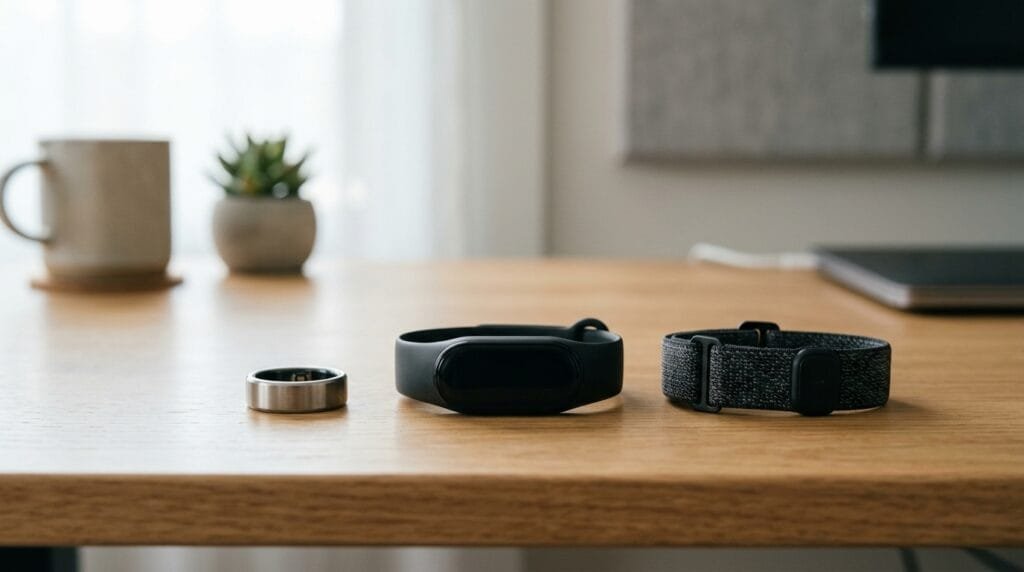
| Factor | Fitbit Air | Whoop | Oura Ring |
|---|---|---|---|
| Form | Screenless wrist band | Screenless strap | Smart ring |
| Upfront price | Low one-time price ✓ | Membership-based | Higher upfront price |
| Subscription | Optional (Premium) ✓ | Required | Membership for full features |
| Accuracy (DC Rainmaker) | Good enough for many | Beat Fitbit Air wrist-to-wrist ✓ | Not in that test |
| Battery | Up to a week (Google) | Check current model | Check current model |
| Privacy | Google ecosystem | Independent company | Independent company |
Competitor prices and plans change often, so check Whoop and Oura for current pricing.
The framing that matters: Whoop is the specialist, Fitbit Air is the generalist. If you’re a serious athlete optimizing recovery, Whoop’s accuracy edge may be worth the ongoing cost. If you want solid health awareness without a mandatory subscription, the Fitbit Air is the better deal.
Leaning toward the Oura Ring instead? We read Oura’s privacy policy to check whether Oura sells your data, what its Palantir deal actually involves, and which settings to change first.
Prefer a ring but don’t want Oura’s monthly fee? See our guide to the best Oura Ring alternatives without a subscription.
Other screenless fitness trackers to consider
The Fitbit Air isn’t the only screenless tracker taking on Whoop. If you’re shopping for the best screenless fitness tracker, two others come up in almost every comparison:
- Amazfit Helio Strap: launched at about the same price as the Fitbit Air, with core features free and an optional paid AI add-on. According to Gadgets & Wearables’ comparison, it’s rated for up to 10 days of battery, the longest of the group.
- Polar Loop: roughly twice the launch price of the Fitbit Air, with no subscription for its software and about eight days of battery. It suits people already using Polar’s training ecosystem.
- Whoop: beat the Fitbit Air in DC Rainmaker’s side-by-side testing, but it’s the only one here that requires a membership.
If keeping your health data away from Google matters most, these are the alternatives to look at first. Check each maker’s current price and data policy before you buy.
We compare these bands, plus the new Garmin Cirqa, side by side in our guide to the best Whoop alternatives without a subscription, including what each company’s privacy policy says.
Who should buy it
- Want serious health tracking without a mandatory subscription
- Already use Android or are comfortable in the Google ecosystem
- Find smartwatch screens distracting and want a simpler wrist experience
- Are switching from Whoop and resent the monthly fee
- Want a small, light tracker you can wear to bed
- Are new to health tracking and want a low-commitment entry point
Who should skip it
- Have concerns about Google holding your detailed health data long-term
- Need the most accurate heart rate and recovery data: Whoop beat it in side-by-side testing
- Want a screen for live stats during workouts: get a smartwatch instead
- Prefer to keep health data outside big tech ecosystems entirely
Fitbit Air bands and accessories
The Fitbit Air’s pebble pops out of its band with a single push, so swapping styles is easy. Google sells three official styles: the Performance Loop, the Active Band and the Elevated Modern Band. Third-party bands are already available too:
- For everyday wear: The OHOTLOVE Silicone Sport Band is a straightforward, waterproof replacement that works for daily wear and workouts alike, a sensible budget pick if the stock band isn’t your style.
- For an active or dressier look: The Magnetic Nylon Active Band uses a magnetic closure instead of a traditional buckle, making it quicker to put on and take off if you’re switching bands often.
Fitbit Air bicep band
Wearing the Fitbit Air on your upper arm is one of the easiest ways to get better heart rate readings, because there’s less light leaking under the band. Google doesn’t sell an official bicep band yet, but it published band design specs so other makers can build them, and early testing of arm-worn setups looks promising. A simple option is this nylon bicep band made for the Google Fitbit Air, which also works as a wrist band.
Want to compare every option, including sizes, bicep bands and dressier leather and metal bands? See our full guide to the best Fitbit Air bands.
Buying a tracker to sleep better? Check the basics too: our research on whether your melatonin dose is too high found that studies used much smaller doses than many bottles contain.
Fitbit Air review: our final verdict
Based on Google’s specs and the in-depth reviews we dug through, the Fitbit Air is the best value in screenless fitness tracking right now. With a low one-time price and no mandatory subscription, it undercuts Whoop while delivering hardware reviewers are genuinely enthusiastic about.
But PrimeDigger can’t ignore what other reviews skip: this is Google. Your heart rate variability, sleep patterns and AFib data live in Google’s cloud. Google promises not to use it for ads and lets you delete it anytime, which is more than many assume. For people already deep in the Google ecosystem, it’s an acceptable trade. For people who guard their health data closely, it’s a real consideration.
OUR RECOMMENDATION
Buy it, but go in with eyes open. Use the three-month Premium trial, set a reminder before it ends, and decide then whether the AI coaching is worth paying for. The hardware alone is one of the best wearable deals in years.
Want the deeper investigation? This is one of the topics covered in The Wearable Scam Bible, our full investigation into fitness trackers, recovery scores and the subscription traps built into modern wearables. Check out the full series →
Frequently Asked Questions
Is the Fitbit Air completely subscription-free?
Yes for the core features. Heart rate, sleep tracking and daily activity work with a free Google account. The AI Health Coach and some personalized insights need Google Health Premium, a paid monthly or yearly plan, so check the current price in the Google Health app. Every Fitbit Air includes a three-month Premium trial.
How long does the Fitbit Air battery actually last?
Google rates it at up to a week per charge. Five minutes of charging adds a full day, and a full charge takes about 90 minutes.
How do you check your workout stats without a screen?
You can’t check stats on your wrist, because the Fitbit Air has no screen. It syncs with your phone, so you open the Google Health app to see your data. That’s intentional: the idea is to train and sleep without distractions.
Is the AI Health Coach on the Fitbit Air actually useful?
Opinions vary, but in-depth reviewers rate it highly: DC Rainmaker said no fitness app uses AI insights better than Google’s. It requires Google Health Premium, so the three-month trial is the easiest way to judge it for yourself.
Is the Fitbit Air worth it?
For most people who want health tracking without a mandatory subscription, yes. You pay once for the tracker, so it’s far cheaper to own than Whoop over time. Skip it if you need the most accurate data or don’t want Google holding your health information.
How accurate is the Fitbit Air?
Good enough for many people, but not the best. In DC Rainmaker’s side-by-side testing, Whoop beat it, partly because the thin band can let light leak onto the sensor. Wearing it snug helps.
Does the Fitbit Air work with iPhone?
Yes. Google says it works with iOS 16.4 or higher and Android 11 or higher, through the Google Health app.
Is the Fitbit Air waterproof?
It’s water-resistant to 50 meters, so you can swim and shower with it, but it isn’t fully waterproof. Google doesn’t guarantee the water resistance lasts for the life of the product.
Does the Fitbit Air have GPS?
No. It has no built-in GPS and uses your phone for location tracking, so carry your phone if you want to map runs or rides.
Sources
- Google: Introducing the new Google Fitbit Air
- Google: Google Health & data privacy
- DC Rainmaker: Fitbit Air In-Depth Review
- DC Rainmaker: Google releases Fitbit Air specs, bicep bands welcomed
- Business Today: Fitbit Air India launch
- Google Health Help: Swim or shower with your Fitbit device
- SlashGear: 5 things to know before you buy the Fitbit Air
- the5krunner: Fitbit Air arm sleeve
- Gadgets & Wearables: Polar Loop vs Amazfit Helio Strap
This article is for general information, not medical advice. If you have a health condition or take medication, talk to your doctor first. Read our Health Disclaimer.