Reader-supported: we may earn a commission from links on this page.
Quick answer: Some stress relief products have real evidence behind them, but less than the marketing suggests. A weighted blanket has the strongest study we found: in a 120-person trial, it sharply improved insomnia and eased daytime anxiety in people with psychiatric conditions. Magnesium may help people who are already anxious, but the research is rated poor quality. Apollo Neuro’s studies were run by its own founders. Aromatherapy shows small effects at best, and CBD gummies are often mislabeled. The free habits further down this page have better evidence than most products.
The wellness industry sells a lot of “calming” products. We went through the published research on five of the most popular ones and graded each on how strong the evidence is, who ran the studies, and whether the product you buy matches what was tested.
Table of Contents
Stress Relief Products, Graded
| Product | Evidence | Our grade | Best for |
|---|---|---|---|
| Weighted blanket | Randomized trial of 120 patients: big improvement in insomnia, less daytime anxiety | Good | Stress that ruins your sleep |
| Magnesium glycinate | Some positive studies in anxious people; reviewers rate the evidence poor quality | Fair | A cheap, low-risk thing to try |
| Apollo Neuro wearable | Small trials run by the company’s own founders | Unproven | Curious early adopters |
| Aromatherapy (lavender) | Small, mostly low-quality studies; modest effects | Weak | Enjoyment, not treatment |
| CBD gummies | Mixed anxiety research; many products mislabeled | Weak | Skip unless lab-verified |
How We Graded Each Product
We don’t test products ourselves. We read the research and asked three questions: Is there a randomized controlled trial? Was it large and well run? And was it independent of the company selling the product? A product only scores well if all three line up.
1. Weighted Blankets: The Best Evidence
Check the current price of the YnM weighted blanket
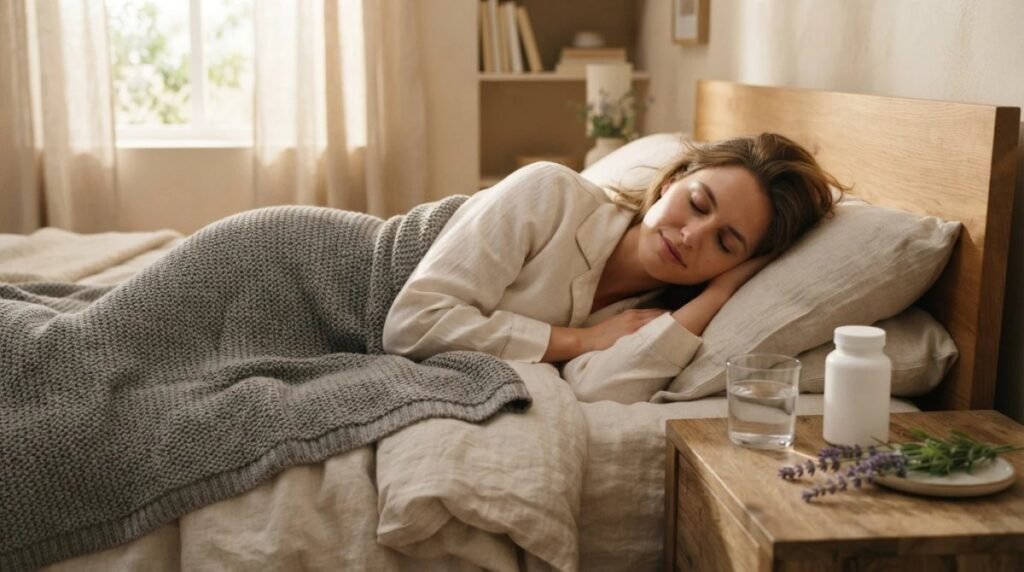
The strongest study we found is a 2020 Swedish trial in the Journal of Clinical Sleep Medicine. It gave 120 patients with depression, bipolar disorder, generalized anxiety or ADHD either a weighted chain blanket or a light one for four weeks. Nearly 60% of the weighted blanket group cut their insomnia scores by half or more, compared with about 5% of the light blanket group. They also reported less daytime fatigue, depression and anxiety, and the benefit held in a 12-month follow-up.
Two caveats. The study tested chain blankets in people with psychiatric conditions, so results in everyday stress may be smaller. And weight matters: the common guideline is about 10% of your body weight. The YnM blanket comes in several weights, so pick the one that matches yours. It’s one of the most-reviewed options, with glass beads rather than chains.
2. Magnesium Glycinate: Cheap, Low Risk, Unproven
Check the current price of Nature Made Magnesium Glycinate
Magnesium is the most-studied supplement for stress. A 2017 systematic review in Nutrients looked at 18 studies. About half of the studies in anxious people, and four of seven in women with PMS, found that magnesium reduced anxiety. But the reviewers rated the overall evidence quality as poor and called for better trials.
Our take: magnesium is inexpensive and safe for most healthy adults at normal doses, so it’s a reasonable thing to try, especially if your diet is low in leafy greens, nuts and whole grains. Just don’t expect a dramatic effect. If you have kidney disease or take regular medication, ask your doctor first.
3. Apollo Neuro: Interesting but Unproven
Apollo Neuro is a wearable that sends gentle vibrations meant to shift your body toward a calmer state. The device came out of a University of Pittsburgh lab, and its trials were run by neuroscientists David Rabin and Greg Siegle, who developed it, according to Pittsburgh Magazine. Rabin is a co-founder of the company. The early trials reported better heart rate variability and focus, but they were small and run by the people behind the product. We’d want to see large, independent trials before calling it proven, so we don’t recommend it as a first purchase.
4. Aromatherapy: Pleasant, Weak Evidence
Lavender is the best-studied scent. A 2019 review of lavender and anxiety found some evidence of benefit, but most inhalation studies were small and of limited quality. If you enjoy a scent in the evening, there’s no harm in it. Just treat it as a nice ritual, not a treatment.
5. CBD Gummies: Mixed Research, Messy Labels
Research on CBD for anxiety is mixed, and many studies used doses far higher than a typical gummy. The bigger problem is labeling. When researchers tested 84 CBD products sold online, a study in JAMA found only 31% were accurately labeled: 43% had more CBD than stated and 26% had less. If you want to try CBD, choose a brand that publishes a recent lab certificate of analysis for your exact batch, and talk to your doctor if you take other medication.
Free Ways to Reduce Stress With Better Evidence
Several free habits have stronger research than most products. Here are the ones with real studies behind them.
- Spend 20 to 30 minutes in nature. In a 2019 study in Frontiers in Psychology, a 20 to 30 minute “nature pill” lowered the stress hormone cortisol. (Seen the cortisol face trend? Here is what doctors say about cortisol face.)
- Try cyclic sighing for five minutes. In a 2023 study in Cell Reports Medicine, a month of daily breathing exercises improved mood, and cyclic sighing (a double inhale through the nose, then a long exhale) worked better than mindfulness meditation.
- Cut caffeine by early afternoon. Your body takes about 3 to 6 hours to clear half of the caffeine you drink, so an afternoon coffee can still affect your sleep at night.
- Write tomorrow’s to-do list before bed. In a 2018 Baylor University sleep study, people who spent five minutes writing a to-do list fell asleep about nine minutes faster than people who wrote about tasks they’d already done.
- Pet a dog or cat. In a 2019 Washington State University study, students who spent 10 minutes petting cats and dogs had lower cortisol afterward.
- Write down what you’re grateful for. In a 2003 study by Emmons and McCullough, people who kept a weekly gratitude list felt better about their lives and were more optimistic about the week ahead.
- Call, don’t text. In a 2012 study, girls who heard their mother’s voice after a stressful task had lower cortisol and higher oxytocin, a bonding hormone, while girls who got instant messages did not.
The PrimeDigger Verdict
Do stress relief products work? A few have some evidence, but none is a cure. If stress is wrecking your sleep, a correctly weighted weighted blanket has the strongest research of the five we looked at. Magnesium glycinate is a cheap, low-risk experiment with weaker evidence. Skip Apollo Neuro until independent trials appear, enjoy aromatherapy for what it is, and avoid CBD products without a lab report. And start with the free habits above, because several have better evidence than anything you can buy.
If you’re going through menopause, hormonal changes can make stress and sleep problems worse. See our guide to creatine for menopause and women over 40. Wondering if stress is turning your hair gray? See our research on what causes gray hair. And if online privacy worries are part of your stress, our guide to removing yourself from data brokers is a practical place to start.
Want the deeper investigation? Our ebook The Supplement Scam Bible shows how supplement labels, dosage claims and “clinically proven” wording mislead, and how to read a label for what it actually says. Get the ebook ($19) → See all our ebooks →
This article is for general information, not medical advice. If stress or anxiety is affecting your daily life, talk to your doctor or a mental health professional. If you’re in crisis in the US, call or text 988. Read our Health Disclaimer.
Frequently Asked Questions
Do stress relief products work for anxiety disorders?
Products are not a substitute for treatment. A weighted blanket trial showed benefits for sleep and daytime anxiety in people with anxiety and mood disorders, but anyone with a diagnosed anxiety disorder should work with a doctor or therapist.
What is the best stress relief product?
Based on the evidence we reviewed, a weighted blanket of about 10% of your body weight, mainly if stress affects your sleep. A 2020 randomized trial of 120 patients found large improvements in insomnia and less daytime anxiety.
Does magnesium help with stress?
Maybe. A 2017 systematic review found that about half of studies in anxious people showed a benefit, but rated the evidence as poor quality. Magnesium is cheap and safe for most healthy adults, so it is a reasonable thing to try. Ask your doctor if you have kidney disease or take medication.
Does the Apollo Neuro really work?
It is unproven. Its early trials were small and run by the neuroscientists who developed the device, one of whom co-founded the company. Independent, larger trials are needed.
Are CBD gummies good for stress?
The evidence is mixed, and labels are often wrong. In a JAMA study of 84 CBD products sold online, only 31% were accurately labeled. If you try CBD, choose a product with a recent lab certificate for your batch.
What is the best free way to reduce stress?
Time in nature, slow breathing such as cyclic sighing, cutting caffeine by early afternoon, and talking to someone by phone or in person all have research behind them and cost nothing.
Sources
- Ekholm et al. (2020), Journal of Clinical Sleep Medicine: A randomized controlled study of weighted chain blankets for insomnia in psychiatric disorders
- Boyle, Lawton and Dye (2017), Nutrients: The effects of magnesium supplementation on subjective anxiety and stress, a systematic review
- Pittsburgh Magazine: Pittsburgh company helps manage stress with new device (Apollo Neuro)
- Donelli et al. (2019), Phytomedicine: Effects of lavender on anxiety, a systematic review and meta-analysis
- Bonn-Miller et al. (2017), JAMA: Labeling accuracy of cannabidiol extracts sold online
- Hunter, Gillespie and Chen (2019), Frontiers in Psychology: Urban nature experiences reduce stress
- Balban et al. (2023), Cell Reports Medicine: Brief structured respiration practices enhance mood and reduce physiological arousal
- Annals of Pharmacotherapy (2008): caffeine timing and half-life
- Scullin et al. (2018), Journal of Experimental Psychology: General: The effects of bedtime writing on difficulty falling asleep
- Pendry and Vandagriff (2019), AERA Open: Animal visitation program reduces cortisol levels of university students
- Emmons and McCullough (2003), Journal of Personality and Social Psychology: Counting blessings versus burdens
- Seltzer et al. (2012), Evolution and Human Behavior: Instant messages vs. speech