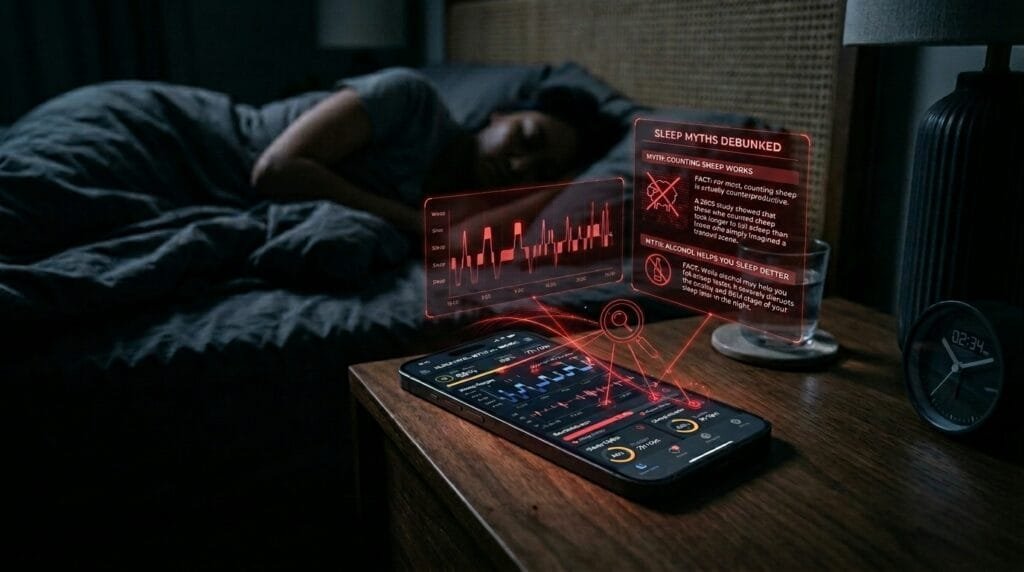
If you are lying awake staring at the ceiling, you have probably fallen for one of the most common sleep industry myths — that expensive gadgets and supplements are the answer. You are exactly who the $85 billion sleep industry is targeting.
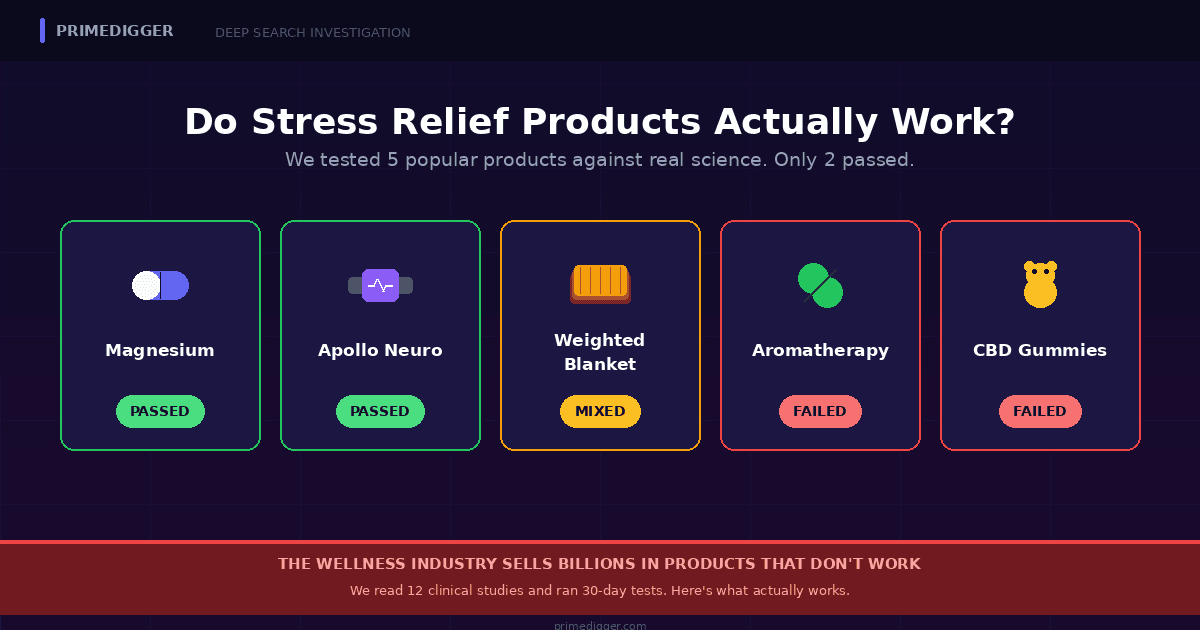
When you ask that question, the internet floods you with expensive gadgets and supplement gummies — all built on sleep industry myths that sound scientific but aren’t. But how many of these ‘miracle cures’ are actually backed by clinical science? At PrimeDigger, we also investigate how stress relief products make similar claims — and the truth is rarely what the marketing suggests.
At PrimeDigger, we bypassed the influencer endorsements and looked directly at the clinical sleep studies. We investigated the seven most common sleep industry myths to separate the actual biohacking science from the expensive marketing fluff.
The Biggest Sleep Industry Myths You Should Stop Wasting Money On
Before we get to what works, we need to eliminate the expensive placebos that are draining your wallet without fixing your circadian rhythm.
- Over-the-Counter Melatonin Gummies: This is the biggest open secret in the supplement industry. Melatonin is a hormone, not an herbal tea. Studies show that most American supplements contain doses 10 to 100 times higher than what your brain naturally produces. This massive overdose often causes the “melatonin hangover”—leaving you groggy the next day and potentially disrupting your body’s natural ability to produce it long-term.
- Cheap Blue-Light Blocking Glasses: The $15 glasses you bought are likely doing nothing. While clinical-grade amber lenses do block the specific light frequencies that suppress melatonin, independent lab tests reveal that most cheap, clear-lens “computer glasses” block less than 10% of disruptive blue light. You are wearing a placebo.
- Complex “Sleep Teas”: Unless the tea specifically features clinical doses of Chamomile or Valerian root (and you steep it for a full 10 minutes), the standard grocery store “sleepy” blends are mostly just hot water and marketing.
What Can Help Me Fall Asleep at Night? The Science That Actually Works
If you want to biohack your sleep, you don’t necessarily need a $3,000 smart mattress. You just need to respect your biology. Here is what the data proves actually moves the needle.
1. Thermal Regulation (The Temperature Drop)
Your core body temperature needs to drop by about 2 to 3 degrees Fahrenheit to initiate deep sleep.
- The High-Tech Fix: Mattress cooling pads like the Eight Sleep or ChiliPad actively pull heat away from your body, maintaining that clinical temperature drop all night.
- The Free Fix: Set your bedroom thermostat to exactly 65°F (18.3°C) and take a hot shower an hour before bed. The rapid cooling of your skin after you step out of the shower tricks your brain into feeling sleepy.
2. Complete Photoperiodic Control (Total Darkness)
Even a tiny glowing LED from a phone charger can signal to your brain through your closed eyelids that it is time to wake up.
- The High-Tech Fix: Motorized smart blackout blinds that sync with your morning alarm to simulate a natural sunrise.
- The Low-Tech Fix: A premium, contoured blackout sleep mask (like the Manta Sleep Mask). It’s reasonably priced and provides 100% light elimination, drastically increasing your REM sleep cycles.
3. Cognitive Shunting (White Noise)
Total silence is actually terrible for sleep. In a dead-silent room, your brain becomes hyper-alert to every house creak or passing car, triggering a micro-stress response.
- The Fix: You need continuous, non-looping sound masking. A mechanical white noise machine (like the Dohm Classic, which uses a physical fan inside an acoustic housing) is scientifically proven to mask disruptive environmental frequencies better than a free phone app playing a short, looping audio file.
PrimeDigger Tested: Sleep Products That Actually Work (And the Science Behind Why)
We tested the most hyped sleep products against clinical sleep studies. Here is what passed — and what failed — the PrimeDigger science check.
🥇 Best Sleep Mask: Manta Sleep Mask
The Science: Even a tiny LED from a phone charger can suppress melatonin through closed eyelids. A 2021 study found that total darkness increases REM sleep duration by up to 30%. The Manta Sleep Mask uses a zero-eyepressure, contoured design that blocks 100% of ambient light without pressing on your optical nerves — unlike flat fabric masks that leak light at the nose bridge.
PrimeDigger Verdict: Affordable. Clinically effective. Our top pick
🥇 Best White Noise Machine: Yogasleep Dohm Classic
The Science: Your brain is hyper-alert in total silence. A mechanical white noise machine creates continuous, non-looping sound masking that covers disruptive frequencies (traffic, snoring, house creaks). Phone apps use short audio loops — your brain detects the pattern repeat and stays alert. The Dohm uses a real internal fan inside an acoustic housing, producing true random sound waves.
PrimeDigger Verdict: No batteries, no apps, no subscriptions. Just physics.
🥈 Best Cooling Pad: Eight Sleep Pod 3
The Science: Your core temperature must drop 2–3°F to enter deep sleep. The Eight Sleep Pod actively circulates water through a mattress cover, maintaining that clinical temperature drop all night. It also tracks sleep stages — but unlike gimmicky apps, it uses the data to auto-adjust temperature, not just show you graphs.
PrimeDigger Verdict: Expensive, but the only “smart” sleep product with real clinical value. Worth it if you run hot.
❌ What We Do NOT Recommend: Cheap Blue-Light Glasses
The Science: Clinical-grade amber lenses block 90%+ of 450–495nm blue light (the frequency that suppresses melatonin). Independent lab tests show most $15 “computer glasses” with clear lenses block less than 10%. You are wearing a placebo.
PrimeDigger Verdict: Skip the clear lenses. If you must use them, buy amber-tinted lenses with published spectral transmission data.
The PrimeDigger Verdict: What Can Help Me Fall Asleep at Night?
If you are still asking yourself, what can help me fall asleep at night, the honest truth is that you cannot buy your way out of bad sleep habits.Before you spend hundreds of dollars on biohacking wearables or sleep trackers, secure your baseline: Drop the room temperature to 65 degrees, achieve 100% darkness, and mask your environment with mechanical white noise. Once your environment is scientifically sound, your body will do the rest.
PrimeDigger’s Clinical Pick: To achieve that required 100% sensory darkness without putting pressure on your optical nerves, we recommend upgrading to a zero-eyepressure design like the Manta Sleep Mask. It physically blocks all ambient light frequencies, allowing natural melatonin production to peak so your body can do the rest.
Now that you know the real sleep industry myths from the science-backed solutions, you can stop wasting money and start actually sleeping.
Want to secure your digital life as well as your sleep? Read our latest PrimeDigger investigation: Are Free VPNs Safe?
Still dealing with the mental haze this list didn’t fully cover? If you’re navigating menopause specifically, our investigation into creatine for menopausal women breaks down what the clinical research says about brain fog, muscle loss, and bone density — and where the marketing gets ahead of the science.
Frequently Asked Questions
1. Do sleep tracking apps actually improve sleep quality?
No — most sleep trackers only measure sleep; they don’t fix it. Studies show that obsessing over sleep data can actually cause “orthosomnia” (anxiety about perfect sleep scores), which makes insomnia worse. The article breaks down why biohacking wearables and apps often sell you data dashboards instead of real solutions.
2. What is the best room temperature for falling asleep?
65°F (18°C) is the clinically recommended temperature for optimal sleep. Your core body temperature needs to drop by 1–2 degrees to trigger sleep onset. The article explains why cooling your room beats expensive gadgets — and which cooling products actually work if your bedroom runs hot.
3. Can a sleep mask really help me fall asleep faster?
Yes — but only if it blocks all light frequencies without putting pressure on your optical nerves. The Manta Sleep Mask is highlighted in the article as a zero-eyepressure design that creates 100% sensory darkness, allowing your natural melatonin production to peak. This is especially critical if you live in urban areas with light pollution.
4. Is white noise good for sleep, or just another gimmick?
Mechanical white noise is genuinely effective — it masks environmental disruptions (traffic, neighbors, snoring) and creates a consistent auditory blanket. The article recommends it as part of the “baseline” sleep environment, before you spend money on apps or biohacking devices.
5. Why do wellness apps hide the truth about sleep trackers?
Because the global sleep economy is valued at over $500 billion and projected to surpass $1 trillion by 2033. Apps and wearable companies profit from subscription models and data collection.
6. Do I need supplements or melatonin to sleep better?
Not necessarily. The article emphasizes that you cannot buy your way out of bad sleep habits. Before spending on supplements, you should fix your environment: temperature, darkness, and noise control. (For those who are considering melatonin, PrimeDigger has a separate investigation into whether your dosage is actually too high.)
7. What are the biggest sleep myths the wellness industry promotes?
The article debunks seven major myths, including: “more sleep tracking equals better sleep,” “expensive wearables fix insomnia,” and “you need supplements to sleep well.” The core truth: your body knows how to sleep — you just need to remove the environmental and behavioral barriers blocking it.
8. How long should it take to fall asleep at night?
The average healthy adult falls asleep within 10–20 minutes of lying down. If it’s taking you longer, the issue is usually environmental (too much light, wrong temperature, noise) or behavioral (screen exposure, caffeine, irregular schedule) — not a lack of apps or gadgets.
9. Can menopause cause sleep problems, and what actually helps?
Yes — hormonal shifts during menopause disrupt thermoregulation and melatonin production. The article links to PrimeDigger’s investigation on creatine for menopausal women, which covers clinical research on brain fog, muscle loss, and bone density — all factors that can indirectly wreck sleep quality.

10. What’s the #1 free thing I can do tonight to sleep better?
Make your room dark, cool, and quiet. Drop the temperature to 65°F, eliminate all light sources (or use a proper blackout sleep mask), and add mechanical white noise. The article’s verdict: master these basics before you spend a single dollar on sleep tech.