
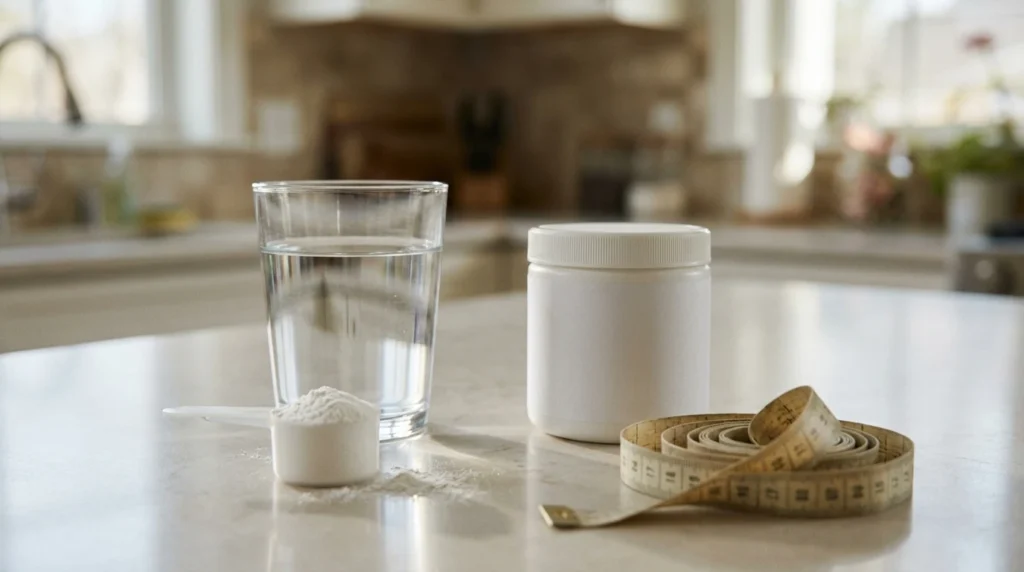
Quick answer: yes, creatine can make you feel bloated, but mostly in the first several days of a loading phase (about 20 g a day). Loading typically adds 1 to 3 kg (about 2 to 6.5 pounds), mostly water, and that water goes mainly into your muscles. Studies lasting 5 to 10 weeks found no rise in total body water. Stomach bloating is a separate problem, tied to big single doses. The simple fix for both: skip loading and take 3 to 5 g a day.
Reader-supported: we may earn a commission from links on this page. As an Amazon Associate we earn from qualifying purchases.
Key Findings
- A 2021 expert review calls water retention in the first several days the most common side effect of creatine.
- Loading at about 20 g a day for 5 to 7 days typically adds 1 to 3 kg of body weight, mostly water.
- Training studies of 5 to 10 weeks found no increase in total body water.
- In a study of 59 soccer players, 55.6% of those taking one 10 g dose had diarrhea, compared with 28.6% of those taking the same amount as two 5 g doses.
- In a small 2025 trial of 24 adults, 79.2% reported some stomach or fluid symptom. The loading group reported more, but the difference was not statistically significant.
- 3 to 5 g a day fills your muscles too. It just takes about 4 weeks instead of one.
Why Creatine Can Make You Feel Bloated
Creatine pulls water with it. When creatine builds up in your muscles, the muscle cells hold more water. That is why the scale often jumps in the first week, especially if you load. Researchers describe this as water inside the muscle cells, not water sitting under your skin.
Stomach bloating is a different thing. Large single servings are linked to stomach upset and diarrhea, which is why the 2021 review suggests keeping servings to 10 g or less.
| Water retention | Stomach bloating | |
|---|---|---|
| What you notice | The scale goes up, muscles feel fuller | Tight or gassy stomach, loose stools |
| Main trigger | Loading at about 20 g a day | Big single doses (10 g or more) |
| When | First several days of loading | Soon after a large dose |
| What helps | Skip loading, take 3 to 5 g a day | Take 5 g at a time, split larger amounts |
Does Creatine Bloat Your Face?
We found no study that measured face puffiness on creatine. The research shows the extra water goes mainly into muscle cells. In the 2025 trial, puffiness was one of the most reported symptoms, but people rated it themselves and the trial had no placebo group, so we cannot tell how much of it was creatine.
Sudden swelling of the face, lips or throat, or trouble breathing, is not normal creatine bloat. Stop taking it and get medical help right away.
How Long Does Creatine Bloating Last?
The research points to the first several days of loading as the main window for water gain. Longer studies of 5 to 10 weeks found no increase in total body water compared with muscle mass. We found no study that gives an exact number of days for everyone.
If you never load, the change is slower and smaller. If you still feel bloated after a few weeks on 3 to 5 g a day, try splitting the dose or switching to a plain monohydrate powder, and talk to your doctor if it does not settle.
Creatine Bloating in Women
Women are underrepresented in creatine research. In the 2025 trial, 81.0% of the women reported at least one stomach or fluid symptom, close to the 79.2% for the whole group. The trial was small and had no placebo, so treat that number with care.
If you are a woman starting creatine, the same rules apply: skip loading and start at 3 to 5 g a day. Our guides to the best creatine for women and creatine for menopausal women cover dosing and products in more detail.
The 2025 Trial: What It Found and Its Limits
| Detail | What the trial reported |
|---|---|
| Who | 24 healthy men and women |
| Design | Randomized, single-blind, 28 days |
| Groups | 5 g a day, or 20 g a day for 14 days and then 5 g a day |
| Symptoms | 79.2% reported some stomach or fluid symptom. Bloating, water retention, puffiness and stomach discomfort were cited most |
| Loading vs standard | More symptoms and higher severity with loading, but not statistically significant |
| Safety | No serious adverse events. Blood and urine tests showed no clinically significant changes |
The limits: there was no placebo group, only 24 people took part, and it is a preprint that has not been peer reviewed. It was funded by Vireo Systems, a company, and its conclusion points toward more soluble creatine forms. A placebo matters here: in the 2008 soccer study, 35.0% of the players on placebo also had diarrhea. Stomach complaints are common even without creatine.
How to Avoid Creatine Bloating
- Skip loading. 3 to 5 g a day for at least 4 weeks reaches similar muscle levels, with less sudden water gain.
- Take 5 g at a time. If you take more in a day, split it into smaller doses.
- Choose plain creatine monohydrate with a clear dose per scoop.
- Weigh yourself at the same time each day. If you do load, expect 1 to 3 kg on the scale.
- Do not panic about the early weight. It is mostly water in your muscles, not fat.
Is Creatine Bloating Harmful?
For healthy people, the research says no. The International Society of Sports Nutrition says weight gain is the only consistently reported side effect, and that well-controlled studies show no rise in stomach upset, dehydration or cramping. It also lists studies of up to 30 g a day for 5 years as safe in healthy people.
If you have kidney disease or another health condition, or you take medication, talk to your doctor before you start.
Plain Creatine Picks for Less Bloating
If you want to start at 3 to 5 g a day, a plain, unflavored monohydrate powder with a 5 g scoop makes dosing simple:
- Optimum Nutrition Creatine Monohydrate: unflavored powder, 5 g per serving. Check the current price.
- Orgain Creatine Monohydrate: unflavored powder, 5 g per serving, nothing added. Check the current price.
Thinking about gummies instead? Lab tests found many gummy brands had far less creatine than the label said. See our creatine gummies investigation first.
How We Researched This
We do not lab-test products. We read the research: a 2021 expert review of common creatine questions, the International Society of Sports Nutrition position stand, a 2008 study of 59 soccer players, and a 2025 trial preprint. We checked each number against the original paper.
Want the full plan? Our ebook The Women’s Strength Bible is a 57-page guide to creatine, protein and muscle for women over 40: how to take creatine, how to avoid gummies that failed lab tests, and a simple two-day strength plan. Get the ebook → See all our ebooks →
Frequently Asked Questions
Does creatine make you bloated?
It can, mostly in the first several days of a loading phase at about 20 g a day. Loading typically adds 1 to 3 kg, mostly water held inside your muscles. Studies of 5 to 10 weeks found no rise in total body water, and taking 3 to 5 g a day without loading causes less sudden water gain.
How long does creatine bloating last?
The research points to the first several days of loading as the main window for water gain. Training studies of 5 to 10 weeks found no increase in total body water. If bloating continues for weeks on 3 to 5 g a day, split the dose or talk to your doctor.
Does creatine bloat your face?
We found no study that measured face puffiness on creatine. The extra water goes mainly into muscle cells. Sudden swelling of the face, lips or throat is not normal creatine bloat and needs medical help right away.
Should I skip the creatine loading phase?
If bloating bothers you, yes. A 2021 expert review says about 3 to 5 g a day for at least 4 weeks reaches similar muscle creatine levels as loading, with less sudden water gain.
Is creatine weight gain water or fat?
The early gain is mostly water. Loading at about 20 g a day for 5 to 7 days typically adds 1 to 3 kg of body weight, mostly water held in the muscles, not fat.
Does creatine cause bloating in women?
It can. In a small 2025 trial, 81.0% of the women reported at least one stomach or fluid symptom, close to the 79.2% for the whole group. The trial had no placebo group, so the real effect of creatine is unclear. Starting at 3 to 5 g a day without loading is the simplest way to limit it.
Sources
- Antonio et al. (2021), Journal of the International Society of Sports Nutrition: Common questions and misconceptions about creatine supplementation
- Kreider et al. (2017), International Society of Sports Nutrition position stand: safety and efficacy of creatine supplementation
- Ostojic and Ahmetovic (2008), Research in Sports Medicine: Gastrointestinal distress after creatine supplementation in athletes
- medRxiv preprint (2025): Gastrointestinal and fluid retention symptoms with creatine monohydrate with and without loading dose over 28 days
This article is for general information, not medical advice. If you have a health condition or take medication, talk to your doctor first. Read our Health Disclaimer.